


The long-awaited “market of one” has finally arrived. In the era of tech-driven hyperpersonalization that is unfolding, companies can engage with their customers in ways that are 100% individualized and increasingly trustworthy — creating massive opportunities over the next few years for those that get it right.
Two megatrends are converging to drive this new age. First, the cloud is evolving from mainly a data phenomenon to something much broader — a rich pastiche of services that are always on, are lightning-fast, and are increasingly adept at assisting individual customers in the moment. At the same time, artificial intelligence is beginning to liberate people from app overload and digital clutter with more natural, human interactions, curated for their needs.
Yet while many financial institutions are using these new capabilities to drive efficiencies in their core operations, their value proposition with customers remains largely the same. Continuing the same old business-as-usual approach to customer interaction is not a recipe for long-term relevance.
Customer-first in financial services means meeting customers at the ‘edge’
To succeed in the years ahead, financial services firms will need a double-barreled approach. In addition to reinventing their core operations, they also need to meet customers where they are, in order to learn and deliver what they need — an area we call the edge. This requires plugging into customer needs and megatrends, pivoting from products to solutions sourced with a “one firm” mindset, and embracing a culture of creative urgency.
Apple founder Steve Jobs was obsessed with the edge. Jony Ive, Apple’s chief design officer, would recount how Jobs would drop by his office and say, “Hey Jony, here's a dopey idea.” Some of those ideas were extraordinary, others not so much. Either way, Apple would learn fast, course-correct, and go on to define and dominate three product categories in one decade (iPod, iPhone, iPad).
Today, a new playbook we call edge-to-core design is taking shape. Versions of it are playing out in several arenas, including enterprise technology (Microsoft), media (Netflix, Prime Video), and mobility (Uber, Tesla). There are also signs of this in parts of the financial services world, as firms like S&P Global and Nasdaq reinvent their roles in the market infrastructure space using acquisitions to accelerate. Both firms are valued at more than 30 times earnings today.
The financial services companies that figure out how to master edge-to-core design will dominate in the years ahead, achieving outsize growth relative to peers and resetting investor expectations.
Edge-to-core design can help financial institutions win the personalization game
Ever since the earliest handheld devices in the 1990s, forward thinkers have been predicting hyperpersonalized and permissioned experiences. In this world, firms bring the effect of personalization to surface the right product or experience in the right moment, powered by data and algorithms. Eight years ago, we argued that firms should embrace a customer-first discipline to create active solutions along these lines.
Today, AI is rapidly accelerating this trend. By AI, we mean the application of algorithms to datasets to derive deep intelligence — about a domain, about a user's context and intent, about the real-time delivery of a service to meet the user in the moment and in context.
The big opportunity lies in using agentic AI interactions to ascertain customer desires and identify solutions, then assemble them from components sourced from the enterprise core and from an external ecosystem of complementary partners. Over time, more and more value will shift to solution assemblers that focus on customer problems and then create ecosystems to meet those needs in ways that feel “by the customer, for the customer.”
Consider a person who sees a cool-looking car and wants to learn more, and maybe even buy one. In the old days, that meant plowing through dozens of auto reviews, blogs, pricing apps, and more. Most of that digging would be totally unstructured, based on the user’s journey through the internet.
Now an AI agent can process the person’s voice command — “That car looks good, what are your thoughts?” — and immediately start assembling services. It can deliver a voiceover of the model specs, reviews, and purchase options that are relevant, while also suggesting more fuel-efficient alternatives and offering head-to-head comparisons, detailing trade-in value of the person’s current car and starting the financing process. What might have been a multi-app, multi-device journey becomes a personalized experience that wraps around the person’s decision path, habits, and needs, either explicit or latent.
How the edge-to-core playbook works for financial services
There are three distinct plays in the edge-to-core playbook that can help financial services firms reinvent themselves for the future.
Play 1: Stake your role in the new ecosystem and prioritize ruthlessly to get it
A major challenge for incumbent firms is how to drive efficiencies in the core while simultaneously freeing up investment to incubate and scale future solutions at the edge. These seemingly competing objectives require different management skills, different metrics of success, and a more centralized financial approach to creating and redeploying capital, talent, and management attention. This is especially hard to achieve for firms with quarterly reporting obligations and value-focused investors.
Yet in our experience, the exercise of framing the future and rebalancing management attention across conflicting priorities can be energizing, and even revelatory, to senior leaders. For example, in the case of one Fortune 200 company, the CEO was so inspired by a reframing discussion that the leader brought it to a board meeting the following week and launched a multiyear transformation program shortly thereafter.
Play 1 unfolds in distinct stages. The first is to step back from the day-to-day as a management team and frame the company’s future role in a five-plus-year timeframe (what we call Horizon 3). This framing should consider three questions: How does the collision of megatrends and customer problems create new or reimagined solution opportunities? What role do we aspire to play in this emerging ecosystem? And what capabilities (new or reinvented) do we need, and how should we source them — build, buy, or obtain through partnerships?
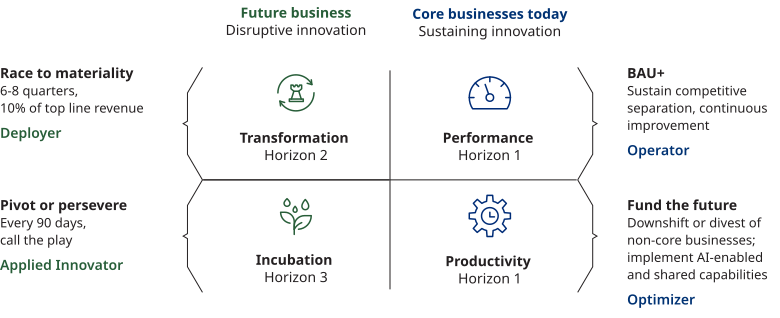
The next step is to align the company’s investment portfolio to the Horizon 3 North Star while honoring near-term commitments. We have found the four zones model originally proposed by author Geoffrey Moore in his book “Zone to Win” to be a helpful way of orchestrating this pivot. Three big challenges will inevitably surface: moving a business or product from the Performance to the Productivity zone, managing for efficiencies and accelerated obsolescence (or divestiture); dealing with the challenge of too many priorities for Incubation; and scaling the right initiatives in the right sequence with sufficient air cover so that they achieve scale and graduate to “new BAU.”
Playing the zones is a disciplined sport with the entire organization leaning in and different leaders playing to their strengths. For example, the best multibillion-dollar business unit leaders may not have the Applied Innovator profile needed to thrive as an Incubation zone leader, nor is the Applied Innovator the obvious choice for driving relentlessly through the Transformation zone and stage-gate hurdles with single-minded focus (Deployer archetype).
Play 2: Create an edge-to-core business architecture
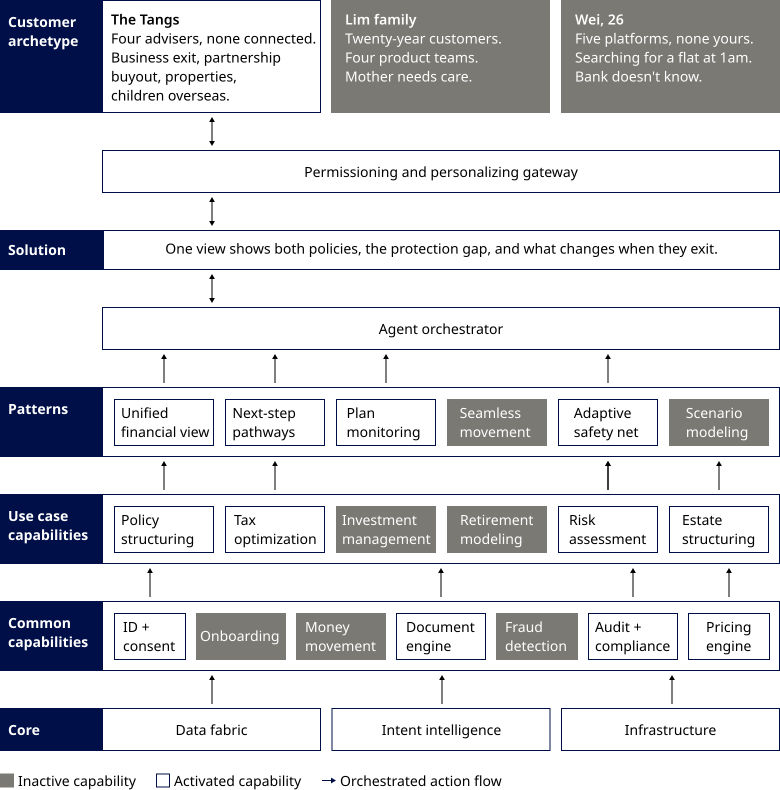
Winning firms of the future will organize themselves differently. The prevailing model for financial services incumbents has become inside-out, as a byproduct of focusing on optimizing their business and driving near-term results. The edge-to-core architecture turns that outside-in. The most successful companies will start from the customer’s perspective, looking for problems the customer needs solved, or their “jobs to be done”— and then organize themselves to deliver solutions faster, at lower incremental cost, with increasing relevance. This approach has four distinct benefits: it focuses attention on what the customer values (and allows firms to stop doing what they don’t); it incorporates a solution assembly layer, which is often absent in legacy models; it reveals overlapping capabilities that can be consolidated into common platforms; and it creates a construct for interdisciplinary work in pods (see Play #3 below).
Today’s environment, powered by emerging AI systems and tools, requires careful consideration and design along four layers. The edge layer should pull customers into a more curated and permissioned experience, where their data can be activated for personalized solutions. To date, no fintech or tech player “owns” the permissioning gateway for safe activation of customer data in a particular context. Below the edge layer is the level where solutions are assembled, triggered by customer events and composed by agents, and from capabilities that are proprietary or sourced from partners (the next layer). The base layer consists of core functions the firm performs, such as data collection and validation.
Why is this model so important? The notion of composability or modularity in financial services is not new. In addition, composability is doable with modern cloud tools and APIs: The modern cloud architectures from Microsoft, AWS, Google, and others all embrace this notion of subcomponents that can be composed into services that enable use cases.
What is new and important: feedback loops to learn from experience and evolve. As the firm receives more signals about what matters to customers — task completion, relevance, confidence — it can sharpen its focus on the capabilities that enable solutions and sunset those that customers do not value. The real power of AI is not the technology, and the technology itself morphs and evolves at a blistering pace. What is powerful is the potential to shift our thinking from devising a target operating model that does what we predict customers need to one that can adapt to ongoing changes in the external world.
The AI-ifying of the economy arrives on the scene at a time of market transition, from historic sources of value powered by a balance sheet to capital-light, data-enabled services. We highlighted this tectonic shift in value in 2022, noting the emergence of new categories of firms in financial infrastructure and technology services (FITS).
Since then, the financial services landscape has become more tech-driven, and the velocity of change in the broader world, and the collision of mega-trends in society more broadly, has intensified. Financial services companies are increasingly competing on the basis of software, with AI as an accelerant. The software world has long pursued the notion of “late binding,” where software adapts to users in real time based on context. Historically there have been tradeoffs — efficiency versus flexibility, deterministic versus adaptable, breadth versus depth. AI changes these tradeoff decisions. For regulated companies, the edge has to abide by regulatory considerations, like auditability. But even these considerations are much more tractable with AI than before. Simply put: The cost versus growth problem is no longer an either-or. Financial services incumbents can use this customer-back framing, powered by AI, to deliver offerings that adapt to use, allowing for targeted reinvention programs that observe the common patterns and distill shared capabilities, and provision these as standardized — more adaptable (late binding) at the edge, more resilient (early binding) at the core.
Play 3: Use an accelerator model to act your way to a better future
Winning at scale tends to breed excellence in managing to KPIs. Most financial services incumbents have a well-honed cost discipline — but today’s challenge lies in linking the cost agenda to a growth agenda. Most companies do not have the muscle memory for incubating and scaling initiatives to reinvent the core while capitalizing on new, AI-driven edge experiences.
The new muscle memory does, however, have some precedent in the applied innovation model of venture capital investors and their portfolio companies, as well as the product development models of big tech players. (But not directly, since incumbent firms have distinct advantages and constraints, such as regulation and investor expectations.) The fundamental goal, though, is similar: Make AI innovation matter with appropriate accountability and metrics, and adjust metrics and execution when an innovation is ready to scale.
As with any muscle-building, this requires training and active learning in what we call an “accelerator model.” This should be loosely coupled from the core enterprise, but tightly linked by governance and transparency.
The model has several key requirements. Firms need to prioritize bets, balanced between efficiency and growth; screen talent for the right behaviors; organize in discipline pods with a “mini GM” leader; adopt a stage-gated process to cocreate with customers and partners and either pivot or persevere; adopt an iterative 90-day-cycle work approach and a learn-fast discipline; set a high bar for incubated opportunities using outcomes-based measures; work with real priorities, framed as customer and business problems; and modernize talent on multiple dimensions: skills, behaviors, interdiscipline collaboration, and mindset.
The accelerator model addresses some important management challenges. For instance, many organizations will lose patience quickly and kill initiatives too soon. Equally challenging, though, is to know when to let go, and not hold on to hope too long. Being crystal clear about outcomes is critical, and can take different forms: for example, making the unknown better known, testing prototypes to validate concepts, or piloting to iron out the inevitable operating challenge. The accelerator model should strike the right balance between flexibility and accountability and enable organizations to move from conviction about edge-to-core possibilities, to confidence in achieving ROI, to sustained commitment and scaling.
The winners and losers of the future in financial services
The market of one is here — and is already creating winners and losers. The providers that thrive over the long term will adopt an edge-to-core approach to focus on solving customer problems first — and organizing around those goals. They will organize in cross-discipline teams that fuse deep customer and domain insight with functional (AI, data, and design) expertise, all team members empowered with joint accountability for outcomes. They will embrace a taxonomy and management model that is inclusive and integrative, and build a new muscle memory that is centered on rapid course-correction and adaptation. Leaders will be first by example along all these dimensions.
Tomorrow’s champions will likely look vastly different from today’s. But one thing is clear: The era of inside-out, product-oriented architectures is no longer suited to the world that has shown up, as AI changes everything.