


Logistics companies are making progress in applying artificial intelligence to streamline back-office functions and enhance physical operations. Although the sector lags behind technology and finance, with AI penetration around 50% compared to 75% and 60%, respectively, according to Oliver Wyman Forum research, significant opportunities remain to automate core workflows and unlock efficiency gains.
Our recent analysis of 25 real-world logistics use cases shows the sector is shifting from experimentation to practical AI deployment. Leading companies leverage AI in both back-office productivity and physical automation to drive a step-change in operational excellence. While 90% of logistics executives express strong confidence in AI's business value, they recognize that there are challenges, including legacy infrastructure and data limitations.
Six key AI use case categories transforming logistics operations
Our analysis reveals six primary categories of capability. Each category addresses distinct operational challenges and highlights significant opportunities. Below, we present one representative use case per category to illustrate AI‘s tangible impact.
- Routine automation in business operations. AI automates routine business transaction processing, including managing inbound emails, quoting prices, setting appointments, and tracking shipments. These applications reduce manual workload and errors, achieving 10% to 20% cost savings within three to six months, with investments typically between €500,000 and €1 million.
- Relational or human interaction support. AI-powered chatbots enhance customer service by managing delivery inquiries, enabling message replays, processing cancellations, and facilitating proactive delivery adjustments. These solutions can handle up to 30% of inquiries end-to-end and cut agent handling time by approximately 50%.
- Expert support. Machine learning optimizes delivery routing and network flow in real time. AI algorithms dynamically adjust delivery routes to boost on-time performance and cost efficiency.
- Predictive analytics. Solutions that forecast estimated time of arrival (ETA) and shipment tracking analyze live and historical data to improve shipment visibility and reduce exceptions and claims.
- Real-time data processing. Vision-based AI systems automate package scanning and defect detection by capturing high-frame-rate images to replace manual scanning, driving accuracy and throughput improvements while enhancing safety through surveillance and driver behavior monitoring.
- Enhanced robotization and automation. Autonomous delivery robots and warehouse automation systems improve physical logistics processes, handling last-mile parcel delivery, sorting, and picking. These technologies optimize warehouse space by up to 30% and reduce fulfillment times by as much as 25%.
Quantifying AI’s cost savings and profit uplift in logistics sectors
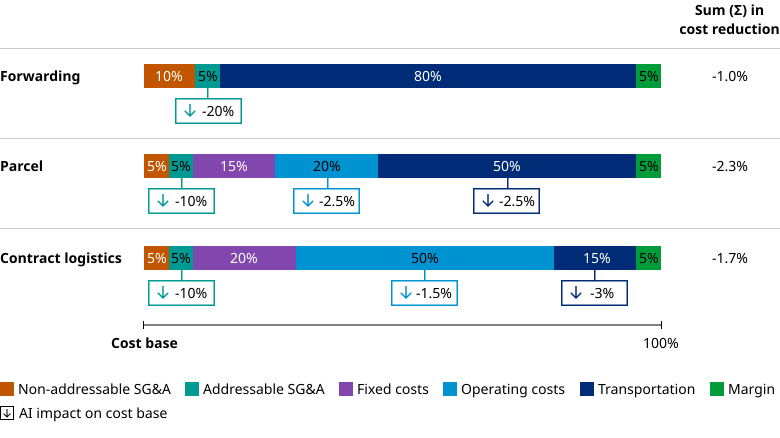
Collectively, these six categories enable logistics firms to target cost reductions between 10% and 25% percent across operational pools such as selling, general, and administrative (SG&A), last-mile delivery, sorting, and warehouse management. This translates into aggregate improvements in earnings before income and taxes (EBIT) of 1% to 2% — a notable uplift for an industry operating on average margins of 3% to 5%.
Most AI use cases reach deployment within 6 to 12 months, with initial investments generally around €0.5 million to €1 million per application. The highest-impact returns are observed in parcel delivery, with a 2.3% EBIT uplift, followed by contract logistics at 1.7% and forwarding at 1%.
Addressing infrastructure, scaling, and ROI challenges in logistics AI adoption
Many logistics firms face difficulty realizing the full return on their AI investments. This difficulty largely results from the sector’s predominantly fixed cost structure in most addressed processes. Even when AI reduces variable costs, the overall effect on operating expenses is capped, limiting the visible impact on profit and loss.
Moreover, in the absence of clear metrics and financial incentives, significant savings generated by AI remain hidden within internal reporting. Without deliberate redeployment or reduction of excess capacity, these benefits are not reflected as actual cost reductions or margin improvements. This opacity inhibits scaling AI beyond pilots and restrains broader economic gains.
Building governance and capability to scale AI in logistics
To scale AI effectively, logistics firms must align AI initiatives to clear business goals, ensuring use cases produce measurable commercial outcomes rather than serving as experimental pilots. Upgrading infrastructure and data ecosystems is essential, requiring investments in connectivity and real-time data management to support expert automation.
Firms need to build governance and accountability frameworks to contain risks, including errors or misleading AI outputs, and to foster responsible deployment. Developing talent with targeted AI training and cultivating a culture of safe, business-led experimentation are also critical. Lastly, organizations should measure impact rigorously, tracking financial outcomes and reinvesting gains to realize true savings.
Currently, most logistics firms allocate less than 15% of their IT budget and under 0.5% of overall revenue to AI. Quick wins are possible through routine automation, but scaling more advanced analytics and physical automation requires a cohesive, phased business strategy and investments.
Strategic AI implementation to secure a competitive advantage in logistics
AI is an operational imperative for logistics operations. Early adopters demonstrate that practical deployments can generate swift, substantial efficiency improvements. The greatest returns begin in back-office workflows and visibility enhancements, with expanding potential in warehouses, sorting, and last-mile delivery.
As AI use cases mature and costs decline, logistics operators face a unique opportunity to enhance margins, improve service quality, and secure a competitive advantage — provided they adopt a business-led, measured, and responsible approach.
