



-

-

-

-
 Link copied
Consumer, Access, Supply Costs, workforce
The Future of the Workforce in Retail And Consumer Goods
Redesigning EVP, pay, and wellness to retain talent
By David Kopsch and Karen Rutledge
-
-
-
- Link copied
What does the future workforce look like for the retail and consumer goods industry? Historically, the retail industry was a place you started work as a teenager working minimum wage. Perhaps you returned during your college breaks to work some shifts, and when you graduated college, you moved on. If you were not going to college, you started at minimum wage and worked your way up to a retail store manager or worked in a consumer goods plant knowing there was a steady income with good benefits.
These were solid career paths that offered opportunity. But now it is becoming more challenging to find people that want to stay in retail and consumer goods for a career. So, the question is, how do organizations make it attractive for people to want to come to work and stay on to develop a lasting career?
Redesigning the employee value proposition in retail
Today’s work environment has faster technological advancements, evolving consumer expectations, and global economic uncertainty in the form of rising costs of inputs and supply chain disruptions. These changes are increasing job anxiety and mental and financial security stress.
The result is an accelerated drop in workforce engagement. In Mercer’s Inside Employees’ Minds study, retail had the lowest engagement score — 65% — of any industry. Retail employees reported dealing with concerns about job stability, inflation eroding purchasing power, and retirement readiness. Also, they have a greater need than their parents’ generation to achieve work-life balance.
In today’s environment, it requires more than a refresh but a complete redesign of the employee value proposition (EVP) to attract, motivate, and retain talent. The pyramid of basic needs has changed and for these employees the basket of goods can be mixed depending on where they are on the career path.
Exhibit: The total rewards pyramid
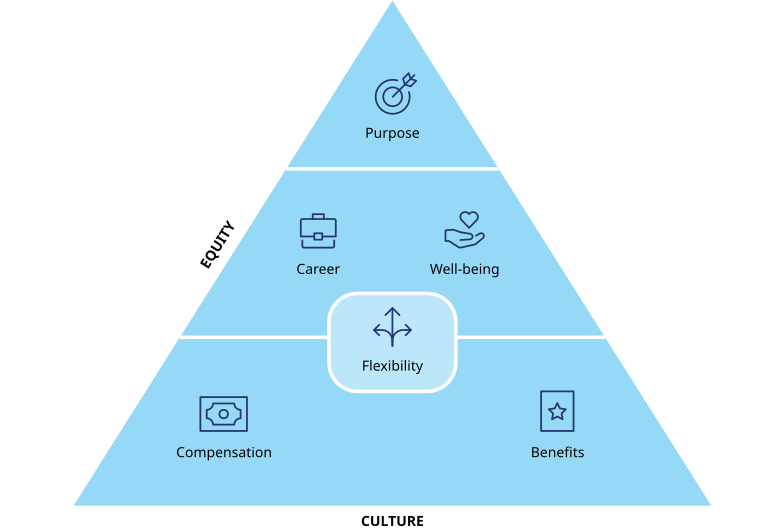
Source: Mercer analysis
Upskilling in AI and automation to reshape retail workforce roles
Labor market dynamics are complex, with structural churn driven by automation and AI taking over routine and repetitive tasks. The retail sector is shifting from traditional roles like stock and inventory management to positions focused on interactive store experiences and multi-channel sales growth. This requires strong emphasis on upskilling (enhancing current skills) and reskilling (teaching new skills for different roles).
There are two central arguments in favor of this evolution. First, it enhances worker effectiveness, while second, it saves time. Whereas previously the employee was searching inventory in the back room or on a central computer, now the employee works with a handheld chatbot to ask, “Do we have this product in-stock and at a competitive price?” What was 10 minutes to search is, in our experience with clients, now less than seven minutes; a full 30% effectiveness time-savings and a better customer experience.
While the AI chatbot helper is replacing work activities, there are digital roles that include a human-in-the-loop. These include marketing (such as customer segmentation using Python), logistics (such as supply chain visibility through blockchain) and customer engagement (such as user experience anthropology) to blend with traditional retail knowledge, for example, the idea of stocking milk in the back of the store to drive traffic through the rest of the store.
This blend has created a ripple that is growing into a tsunami because it is changing how work gets done, how work is defined, and how the employee learns to do the job and is paid to do it. It necessitates continuous reskilling and upskilling to keep pace with changing job requirements, as well as a modernization of pay practices.
Building workforce agility through continuous learning in retail
Continuous learning is essential due to rapid technological and business changes. The retail and consumer goods industry must foster a culture of adaptability and provide frameworks supporting lifelong learning, curiosity, and motivation for ongoing skill development, and ultimately the industry’s survival. Yet while companies are always creative and innovative when it comes to attracting and retaining customers, they continue to reward performance and development as they have for the last two decades.
Future retail roles will demand technical skills such as data engineering, robotics, software development, cybersecurity, and user-experience design. Beyond technical skills, there will be growing demand for creativity, critical thinking, complex information processing, and social-emotional skills like communication, negotiation, leadership, adaptability, persuasion, and empathy — especially for customer-facing and managerial roles.
Work is shifting, jobs are changing, and the workforce is not prepared. As Mercer’s HR Operating Model’s 2025 Survey puts it, “Without a fundamental rethinking of how HR roles, governance, and service delivery tiers are designed, organizations risk staying stuck as Stewards of Employment, layering new tools onto outdated frameworks rather than unlocking the agility and human-centered outcomes demanded today.”
Enter the chief work officer, yesterday’s chief talent management and learning officer. Continuous learning is no longer optional — it is essential. Consumer goods companies must invest in robust learning and development programs that enable employees to acquire digital, analytical, and adaptive skills. Cultivating a culture of lifelong learning ensures that the workforce remains agile and competitive.
Compensation strategies driving workforce transformation
Between AI and the emergence of more blended, or fluid, roles, traditional pay programs are not structured for the workforce of the future. The greatest return on investment (ROI) is in modernizing pay practices to reward the skills, expertise, and responsibilities required for these new types of roles. Deliberately design compensation to encourage upskilling and reskilling by linking pay progression, bonuses, or other rewards to skill acquisition and certifications.
The total rewards revolution is changing how rewards can be elevated for long-term success, according to Mercer’s Rewards Revolution report. Reject the notion of total rewards as a cost center. Compensation is integral to enabling workforce transformation by aligning rewards to employee growth, performance, and agility.

Holistic approach to employee wellness builds resilience
Employees in the consumer goods and retail industry are navigating a fragile ecosystem between how work is changing and impacting jobs. According to Mercer’s Global Talent Trends study from 2025, only 42% of companies have made progress in designing work with employee well-being in mind. The percentage of employees feeling physically and mentally well has declined from 82% in 2023 to 74% in 2025, Mercer Marsh Benefits’ 2025 Health on Demand report finds.
Mercer’s 2024-2025 Inside Employees’ Minds data shows the workforce navigating waves of growing financial strain and mental overload and burnout. Mental and financial wellness are integral components of a holistic approach to the total rewards needs of the workforce. Winning employers are investing in counseling services, enhanced employee assistance programs, and initiatives that reduce stigma around mental health challenges. Additionally, employers are offering trainings, onsite screenings, giveaways, and challenges to further engage their population.
Prioritizing employee health delivers tangible business benefits beyond individual well-being. A culture of caring should not be underestimated. It starts at the top: Leaders should be visible in their well-being programs — participating during company town halls, being open about their own journeys, and encouraging people to take care of themselves.
AI-powered analytics provides real-time data to tailor health interventions and predict risks, allowing for more effective and efficient health programs. It is also a means to find where current programs are not meeting the needs of the workforce, which may yield savings by eliminating irrelevant programs. The organizations that embrace the data will be better positioned to foster a healthier, more engaged workforce.
Employees’ financial security is an integral component that must be addressed as well. Employees are worried about their ability to save for retirement amid rising living costs. Inflation is negating the rise of wages, which is affecting consumers’ purchasing power and financial security, and by extension their morale and productivity. Progressive companies are investing in financial wellness programs to help employees manage day-to-day expenses, reduce debt, and plan for long-term goals like retirement. Investing in employee financial security benefits the employer by allowing the employee to be more present at work, reducing absenteeism and turnover, and improving productivity.
Key actions to transform retail and consumer goods talent
Retail and consumer goods companies must adapt to demanding customer needs, wants, and nuances on a daily basis, while maintaining profitable margins to serve tomorrow’s customer. By taking these key actions, they can lead with a people-centric strategy workforce of the future.
1. Redesign the Employee Value Proposition (EVP): Move beyond simple updates to create a comprehensive EVP that attracts, motivates, and retains talent amid rapid change and workforce anxiety.
2. Focus on upskilling and reskilling: Invest heavily in continuous learning programs to equip employees with both technical skills (such as data engineering, robotics, and cybersecurity) and essential soft skills (such as creativity, communication, and adaptability) needed for evolving roles.
3. Modernize compensation practices: Align pay and rewards with skill acquisition, expertise, and responsibilities by linking compensation progression and bonuses to upskilling and reskilling efforts.
4. Cultivate a culture of lifelong learning: Foster adaptability and curiosity by embedding continuous learning into the organizational culture, led by roles like the chief work officer.
5. Prioritize workforce wellness holistically: Address physical, mental, and financial well-being through comprehensive wellness programs, including mental health support, financial wellness initiatives, and use of AI analytics to tailor health interventions.
The future workforce in the consumer goods industry will be defined by leaders who proactively and continuously embrace investing in their people just as they proactively and continuously respond to the demand of the customer. The journey toward workforce transformation is complex, but it is essential for sustainable success in an increasingly competitive and dynamic marketplace.


