


The defense market values secure and resilient supply chains, but with the caveat that there is a clear price ceiling. Resilient sourcing is achieved by actions that help sustain output through disruptions. That can include qualifying alternative suppliers, expanding available capacity, or securing additional inventory, to name a few options. These capabilities require significant upfront investments — premiums that suppliers currently appear unwilling to fully absorb by reducing profits or by carrying higher working capital costs.
Our 2026 survey of more than 160 US defense suppliers found that 96% of respondents would consider a 5% premium for more resilient sourcing. Nearly 80% remained inclined at a 10% premium, but willingness collapsed at 20%, with only 10% saying they would support that investment.
At the same time, the supply base has not built enough qualified redundancy. Only 17% of all respondents say they have achieved broad, systematic multi-sourcing across critical components, while 42% report having limited or no multi-sourcing. This gap is most pronounced among the lower-tier suppliers.
If the market values resilience, why has it not been willing to pay for it? That’s the paradox for the defense industrial base.
Companies tend to invest in resilience too late, measure it with the wrong proxies, or compare it against more visible price premiums. Thus, the true cost of supply base fragility remains hidden. Because structural demand uncertainties are unlikely to change for the US defense market, suppliers should be building flexible and resilient supply chains capable of performing under every condition, rather than patching them when the system breaks down.
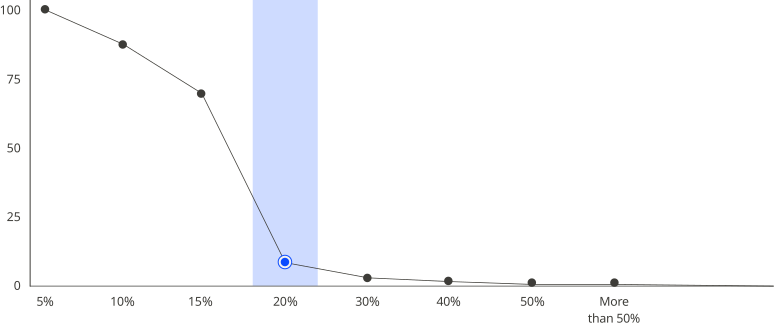
Three mismatches that deepen the supply chain resilience paradox
The resilience paradox is not simply a question of how much customers are willing to pay. It reflects a deeper disconnect between when resilience is valued, how it is measured, and how its true costs are assessed. Three mismatches help explain why the market continues to underinvest in resilience.
Defense supply chain resilience is purchased too late
Customers typically value resilience at the transaction and sourcing stage, when comparing unit prices, lead times, and capacity. By then, investment and design decisions that determine resilience have already been made, and it may be too late to quickly create an alternative in the event of a production disruption. Specs may limit acceptable materials, processes may depend on proprietary tooling, and alternate sources may require lengthy testing, validation, or certification.
The market values outcomes, but purchases inadequate proxies instead
Ultimately, customers value continuity of output: How much production can be maintained in the face of disruption, and how quickly can full production rates be restored? On the other hand, suppliers tend to assess resilience using proxies such as supplier count, inventory, or stated capacity — indicators that can lead to a sense of false confidence. Having two approved suppliers may not improve resilience if both rely on the same material source, tooling provider, or labor pool. Without visibility into common dependencies and realistic recovery timelines, companies may be buying the appearance of resiliency, rather than a real ability to fend off disruption.
While the price of resilience is visibile, the cost of fragility is not
A higher price is concrete and easy to see when sourcing components. Less visible are the costs created by supply-chain fragility. These include excess reserve capacity and inventory, schedule buffers, expediting premiums, and management time and attention, among others. A key finding of our original survey was the “trust tax”: that’s when suppliers hold reserve capacity because of sub-tier delivery risk. The trust tax means companies are paying materially for unreliable supply via fragmented costs that are less visible than a unit-price premium.
How defense suppliers can build more resilient supply chains
The answer for suppliers is not to create duplicate capacity. Instead, they should prepare for disruptions earlier, target the most important constraints to production, and reduce the cost and time needed to recover.
Design resilience into the process before production begins
Procurement cannot economically multi-source components if engineering specs are overly complex or qualification processes are difficult to transfer. Suppliers should incorporate a resilience review into any new product introduction, design release, or major configuration change. The review should test whether specs unnecessarily restrict available sources, whether alternate materials or processes can be approved in advance, and whether tooling, inspection methods, or other technical data can be transferred.
The goal is not to eliminate specialized requirements, but to distinguish mission-critical needs from choices that create avoidable dependence on one material, process, asset, or supplier. Suppliers should surface these constraints and propose alternatives before entering production.
Manage supply chain recovery time, not number of sources
For each critical component or process, suppliers should ask: If this capability were lost, how long would it take to restore output?
Relevant measures include time to switch sources, output recoverable within 30, 60, or 90 days, and tooling or qualification lead times. The appropriate intervention will vary for different risks. If a low-cost component will bring production to a halt if unavailable, then multi-sourcing may be justified for that part. In other cases, an approved material alternative, tooling spares, inventory buffer, or cross-trained workforce may suffice as protection.
Preserve options to scale and strengthen supply chain resilience
Suppliers will be averse to large speculative investments to build capacity while defense program timing and volumes remain uncertain. Instead, a more practical approach is “qualification first, capacity second.”
Suppliers can prequalify alternate materials, maintain current process-transfer packages, validate alternate production routes, and invest in modular tooling or critical spares. These actions do not eliminate the need for future investment, labor, or facilities, but do reduce time, cost, and execution risk when demand or disruption becomes real. In the face of uncertainty, resilience should act as a portfolio of executable options, not a warehouse of idle capacity.
Redirect the trust tax to fund resilience in defense manufacturing
Suppliers should assess the costs of supply chain uncertainties, including reserve capacity, excess inventory, expediting, emergency sourcing, rework, lost throughput, and management time. They can then compare those reactive costs against targeted resilience interventions.
That’s not to say every buffer must be removed. It’s rational to have insurance in place. But the funding for resilience may already be there. It is just distributed across the many hidden costs of operating a fragile supply chain.
Shifting defense supply chains from redundancy to recoverability
The defense market will continue to operate amid inherent demand uncertainties, and companies are unlikely to pay unlimited resilience premiums. That said, suppliers can make resilience more economically viable. The most resilient supplier may not be the one with the most extra capacity. But it will be the one that can restore output fastest, at a cost the market can sustain.