

Consolidation has been altering the asset management market for several years. The rationale for adopting a merger and acquisition (M&A) strategy is usually centered on a few objectives: achieving scale, broadening capabilities, strengthening distribution, and improving operating leverage.
Achieving those goals is critical as economic pressures intensify. Asset management remains a profitable industry, but fee pressure and modest net flows (see exhibits one and two) are making it harder to grow revenue (without significant support from market appreciation), while the investments needed to stay competitive continue to rise. Firms must spend more on technology, including artificial intelligence (AI); data, investment and distribution talent; and support functions like risk and compliance. That puts a particular strain on mid-sized managers, which often try to compete across a wide range of products, client segments, and geographies without having the scale to absorb all those fixed costs.
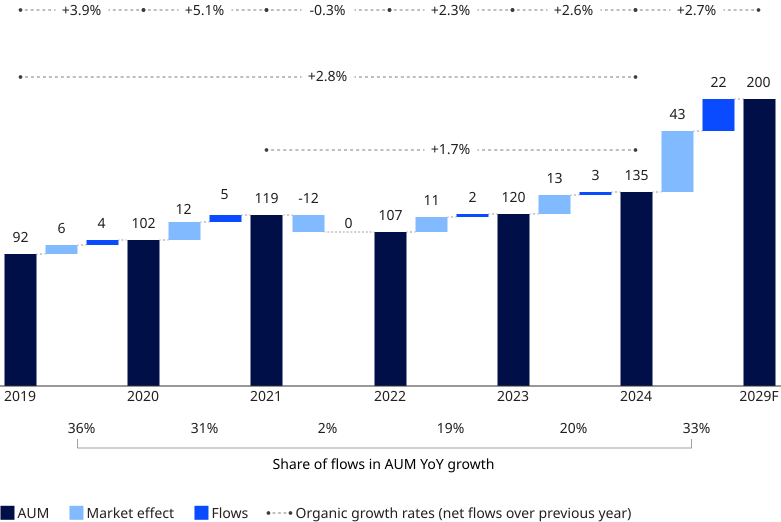
The increased concentration of flows and fundraising, for example, success is also highlighting investors’ preference to “do more with fewer,” pressuring managers to expand the scope of products and solutions they can offer.
As a result, M&A activity has accelerated across the industry. The 2025 Oliver Wyman and Morgan Stanley Global Wealth and Asset Management report estimated that the industry could see 20% fewer wealth and asset managers and more than 1,500 significant transactions by 2029. In fact, transaction activity reached a new post-COVID level, with more than 200 significant wealth and asset management deals per year since 2022, roughly twice the rate of the previous decade.
While M&A can make strategic sense, the outcomes were often mixed. Our analysis of recent large asset management transactions suggests that fewer than 40% improved cost-income ratios three years after closing. Many struggled to deliver sufficient revenue growth, either because cross-selling proved harder than expected or because client and asset attrition offset planned upside.
Change in cost-income ratio 3Y post-merger in percentage points
Net flows into funds and ETFs over 3Y post-merger in $BN
The challenge facing most deals is post-closing execution. Although M&A is increasingly becoming a core strategic lever, competitive advantage will not accrue simply to the most aggressive acquirers. Rather, it will accrue to firms that can repeatedly translate deal logic into realized value. It’s what we call the integration alpha: the ability to capture the financial and strategic benefits of a transaction while minimizing value leakage due to client attrition, talent departures, operational disruption, cultural friction, and delayed decision-making.
The six practices behind high-performing post-merger integrations
Based on our work with leading asset managers, we see six practices that consistently help achieve success in post-merger integration and distinguish performance from peers.
1. Start every post-merger integration with a clear strategy
Many deals fail because the primary rationale for pursuing M&A was not specific enough to guide integration choices.
Rather than relying on broad concepts such as scale benefits, distribution synergies, capability expansion, or platform leverage, effective consolidations are guided by measurable outcomes that determine whether the transaction succeeds.
Before executing a deal, leadership teams should ask three critical questions:
- What are we actually buying?
- Where could integration go wrong and negatively impact the value of what we are acquiring?
- Which three or four metrics will ultimately determine success?
This pressure test will shape diligence, valuation, synergy estimates, retention planning, communications, governance, and the integration posture itself.
2. Select the right integration approach to maximize value
Integration is not a binary choice between full integration and complete autonomy. Finding the right answer depends on the deal thesis.
A merger to achieve scale between overlapping traditional managers may require significant integration of operations, technology, finance, risk, compliance, procurement, and parts of distribution. A capability acquisition, such as a private-markets specialist or high-alpha investment boutique, may require a lighter touch around investment processes, compensation, brand, and client-facing talent. A distribution-led deal may require rapid integration of coverage and sales-incentive compensation models, but more caution around product rationalization and client migration.
Each choice carries trade-offs. Full distribution integration may increase cross-sell potential, but it can also create client confusion and internal competition if roles and incentive compensation models are unclear. Rapid product rationalization may reduce complexity, but it can trigger adverse impacts on portfolio management teams, awkward client inquiries, and spikes in consultant concerns, to name a few. Preserving investment autonomy may protect the alpha-generation process, but it can also limit platform leverage and create unproductive siloing.
The key is to ensure that trade-offs are weighed carefully and decisions are made based on measurable outcomes and achieving the expected value proposition.
3. Build a talent retention strategy that protects deal value
Talent retention is central to any deal, but it is especially important in asset management. Roughly 40% of critical talent leaves within 18 to 24 months after close, according to Mercer, a Marsh business. The loss of talent can quickly lead to a loss of clients, assets under management (AUM), investment performance, institutional knowledge, or operating resilience.
In addition to focusing retention efforts on senior investment professionals, business development leaders, and client service executives, companies need to consider talent across the organization.
A robust talent assessment should identify four categories of value at risk:
- Revenue-linked talent: portfolio managers, sales leaders, relationship managers, consultant-relations professionals, product specialists, and others directly tied to client retention and asset growth.
- Investment and capability owners: individuals whose judgment, process knowledge, or credibility sustains the investment proposition that justified the deal.
- Operational and control failure points: risk, compliance, operations, data, reporting, technology, and finance professionals who keep the platform functioning and prevent disruption.
- Informal influencers: people with deep internal networks, cultural credibility, or institutional knowledge who can either accelerate or slow integration.
Importantly, retention strategy should also go beyond compensation. Role clarity, career path, decision rights, platform access, leadership attention, and pride in the future organization are important factors, too.
Retention should then be measured through a value lens: AUM linked to retained teams, client coverage stability, consultant feedback, employee engagement, and voluntary attrition in key roles.
4. Align incentives to protect and grow long-term deal value
Compensation is one of the most sensitive and value-critical elements of asset management integration. Differences in incentive structures should not be ignored if the deal thesis depends on a more integrated investment, product, or go-to-market platform. What’s needed is a deliberate path that reflects the role, the value at risk, and the strategic intent.
The most successful integrations establish a clear path toward alignment while recognizing that different groups may require different solutions. Immediate harmonization may work where roles and performance measures are comparable. Transitional arrangements may be needed where legacy structures differ materially. Select carve-outs may remain appropriate for investment teams or alternative businesses where compensation models are inextricably linked to the value proposition.
Above all else, transparency matters. Leaders should explain how the firm is balancing retention, fairness, performance, cost discipline, and long-term strategic alignment. This is particularly important in distribution, which is central to achieving revenue synergies. If sales teams are expected to cross-sell legacy and acquired products, the compensation model must explicitly support that behavior.
5. Drive value capture through strong integration leadership
Many integrations fail because there is insufficient accountability and clarity for value capture. Successful acquirers make integration a leadership discipline by appointing an integration leader with authority, not merely coordination responsibility. They assign business owners to each major value lever and embed synergy targets into budgets. They also create a list of decisions that must be escalated quickly.
And they maintain an integration dashboard that tracks both value-capture and value-protection metrics, including retained AUM, client attrition, net flows, consultant feedback, client consent progress, investment team retention, voluntary attrition, cost synergy realization, platform migration risk, product rationalization, operational incidents, and employee engagement.
Firms should embed rising internal talent in the integration team and document lessons learned so each deal improves the next one. In a consolidating market, repeatable integration capability becomes a strategic asset.
Day one also matters more than many leadership teams assume. Employees form views quickly about whether the new organization is disciplined, empathetic, and credible. Basic failures like unclear reporting lines, broken system access, conflicting client messages, and delayed role decisions can cause disproportionate damage.
6. Turn cultural differences into better operating decisions
Culture is often used as an excuse when integrations underperform. Sometimes that diagnosis is accurate. But culture is also a convenient label for more specific issues: unclear decision rights, incompatible risk appetite, slow governance, misaligned incentives, lack of trust, weak communication, or inconsistent client priorities.
Effective leaders use culture as a diagnostic tool to inform important integration choices. Cultural differences often emerge around investment autonomy, governance, decision-making processes, performance expectations, and the relationship between investment and distribution teams. These differences shape how organizations behave and how effectively they operate after a merger.
The challenge is to translate cultural signals into the design of the operating model. Which decisions remain with investment teams? Which requires enterprise governance? How should escalation paths work? What behaviors will leadership reinforce?
Why integration alpha matters more than ever
In a market where scale, capabilities, distribution access, and capital are becoming harder to build organically, M&A will remain an important path to drive growth and enterprise value. But M&A only creates value when the combined organization can capture the elusive alchemy of deal synergies. That is the essence of integration alpha — the systematic ability to realize those synergies, not just once, but consistently over time. In the coming consolidation cycle, it may become one of the most valuable capabilities an asset manager can build.