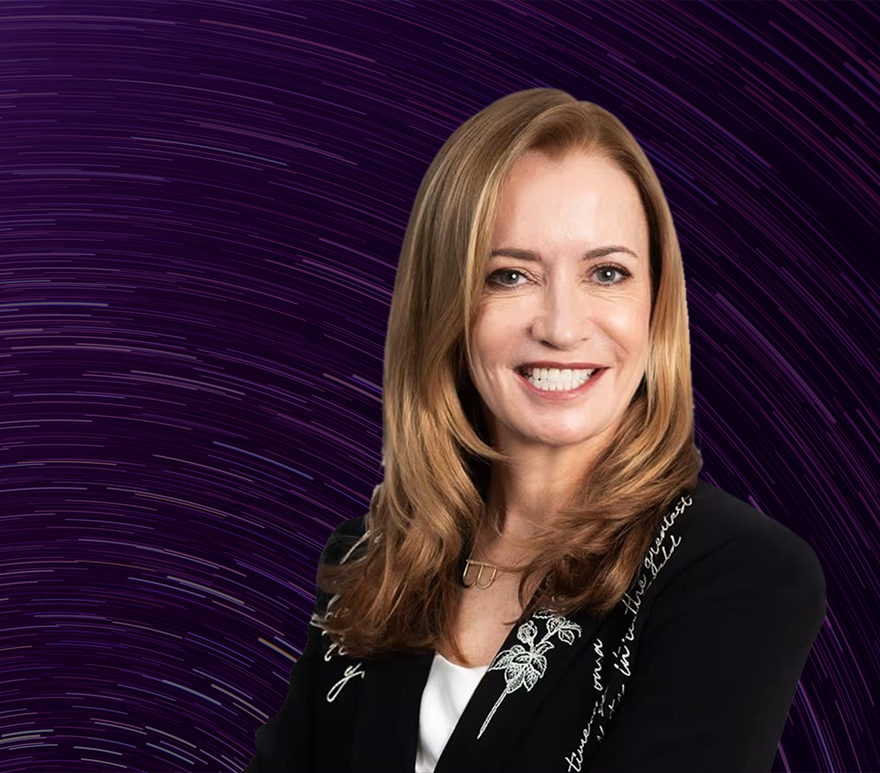
Hiten Patel: On today's episode of the Innovators Exchange, I'm delighted to welcome industry titan Blythe Masters. Very few in the world will have the lasting impact on the financial services sector that Blythe has had. Trailblazing across banking and markets, digital assets, private equity investing, and most recently, the CEO of a leading financial technology and data company. We look forward to hearing Blythe’s reflections on her journey today and what lies ahead. Welcome to the show, Blythe.
Blythe Masters: Thank you. It's a great pleasure to be here. Very kind.
Hiten: Perhaps begin with an introduction to your current role.
Blythe: Absolutely. So, as you mentioned, after a career that's been circuitous, I am the CEO of FNZ Group. FNZ is a global technology platform that serves an array of wealth businesses around the world. We process somewhere approaching 2.3 trillion U.S. dollars, notional equivalent of assets. On behalf of end customers that number is more than 30 million around the world today.
Hiten: Super, so, we'll double click into the wealth space and FNZ in a moment, but I always like to get guests to rewind the tape, start the journey at the outset. I'd love to hear your reflections on, I guess, early years education. What was the foundations that has kind of enabled everything that followed in your career?
Blythe: We're going to need some extra time to rewind all that tape. Let's see. Well, I'm a Brit. I have actually spent the last 33 or so years living and working from the United States, although in some respects, I'm something of a global citizen.
I spend a lot of time traveling. I grew up in the Southeast of England, Sussex and Kent. Went to school in Canterbury. And later at Trinity College, Cambridge, where I read economics. And funnily enough, my career in financial services actually started before going to university, when I was taking a gap year aged 18, approximately, when I wanted to travel the world.
I was a penniless student, needed to fund the travel, and wrote, I think, 13 letters to banks in London. I didn't know the difference between a high street bank, a commercial bank, an investment bank, a merchant bank. And two of them replied, one of which was Morgan Guaranty Limited, which is the predecessor firm of what is today the behemoth, JP Morgan Chase.
And they offered me a job as a temp. And I showed up in the late 1980s, and my first job, actually, was photocopying, which it proved I was quite good at, an amazing skill. But it was quite boring. And what actually happened was that in the process of photocopying and binding, actually, not just photocopying very large documents that were, you know, more than an inch thick, I had the time to start reading them, and it turned out that what I was photocopying was longform.
There was no such thing as short form in those days. Swap documentation. So, this was the very, very beginning of the derivatives era in financial markets. And swaps were negotiated by appointment. Read somewhat like loan documents in some ways. And they were, you know, quite hard to follow in dense legal prose, as you might imagine, which led to me asking a senior person in the vicinity to explain the whole thing to me.
And one thing led to another, and I ended up working in the derivatives business, in a more substantive way than photocopying. From that point forward, for a good part of the gap year that I took off between school and university. And that's how it all got started.
Hiten: Wow. There is a lesson there for everyone who is kind of starting out, trying to hustle, get an entry point.
Blythe: Absolutely.
Hiten: Because you then had quite a foundational impact on the derivatives market, right? As, I guess you joined JP Morgan after Cambridge?
Blythe: I did, yes. So, that would have been 1987, a gap year. My Cambridge three years were spent with the summers doing internships with the bank. The last of which, before I graduated, was actually the summer of 1990, when I joined the then approximately four-man strong global commodities group, which was going through a convulsion as you might recall, because the first Iraq war took place that summer, which made for that internship being quite an extraordinary experience.
I showed up in New York, actually, not London, and was handed two phone sets, big, clunky black things, and was told to start buying oil and continue until, you know, given notice to stop. I literally didn't know whether oil traded in buckets or barrels or bushels. And the other end of the line was the nomics, trading for the futures exchange.
And the firm was hedging the consequences of having sold fixed price jet fuel swaps to airlines. And the resultant basis risk, which exploded between kerosene jet fuel prices and crude oil. So that was my introduction to corporate derivatives. And by the time I graduated a year later, I joined the commodity business permanently.
Initially based in London, spent several years in the commodity derivatives space, initially in London, and then was asked to move to New York for a six-month assignment. Never went home. So, 33-ish years later I'm still based in the U.S. And after working in commodities I moved into investor derivative marketing. Spent time working in and around most forms of derivatives, both as a trader, subsequently as a structure marketer, and ultimately running those businesses. And, somewhere along the way in the early 90s, I was asked to explore a relatively novel concept, which I'm not even sure was really called credit derivatives yet. But was an idea. It's thus, I was not the inventor of credit derivatives, although the internet says otherwise.
I would love to lay claim to that intellectual achievement, but I remember first having a credit derivative or a concept that looked like one explained to me. But what I was asked to do was to think about how this could become a line of business for JP Morgan. And I began a journey several years long that helped popularize, institutionalize credit derivatives as a tool, both for investment and for risk management.
And there were many aspects to that working with ISDA [International Swaps and Derivatives Association], working with rating agencies, working with regulators, working with customers, working with the risk management departments, internally and externally. And credit derivatives as a financial instrument became obviously one of the many financial instruments that are routinely used today. So, as I say, I would love to lay claim to having invented all of that, but I certainly helped popularize their deployment.
Hiten: You’ve definitely left a mark on the industry. I guess more telling for me, actually, is hearing the start of that journey. Photocopying those documents and reading it. So, there's definitely a circularity there. Just for the benefit of the listeners who try and navigate their careers through large institutions, talk to us a little bit about what informed or guided some of those transitions within such a large-scale successful institution like JP Morgan? When you talk about quite a few transitions, what guides and informs those as other people are trying to think about navigating their paths in large institutions?
Blythe: It's a good question. And there were many more after that. I went on to become the CFO of the global investment bank. I ran global credit portfolio and credit policies. This is the part of the firm that looks after retained credit risk from lending and derivatives activity. I went back to run and build the global commodities business later on in a later stint. So, I made quite a few lateral moves, in the course of a long career that was more than 27 years all told, if you include the summer internships in the gap year with JP Morgan. And I would say on average, roughly every two to three or four years, I made a move of some nature.
Some of those were sort out on my part. Some of them were thrust upon me. And I would say that really, over time, I developed a capacity for being able to take on and embrace new opportunities, which has two parts to it. One is planning to let go of the thing that you're comfortable in and with, and perhaps associated with, that's your baby, and move into the unknown, which often can feel uncomfortable or unexpected.
And that capacity that I developed meant that I became known as someone who could build or change or fix things, and that wasn't a purposeful thing that I set out to create as a sort of label at the outset of my career. It came, however, I think from being a hard worker, being curious, and interested not just in the perimeter of my day job, but what else was going on in the world and being a risk taker, willing to take risks.
Not necessarily just in the sense of being a professional risk taker but being willing to take career risk. And over time, you know, becoming keen to do that because the best way to broaden your horizons and deepen a skill set over time in a big institution like a JP Morgan is to do different things, which, of course, an institution of that nature does affords you without the need to leave an institution where you've developed political capital and goodwill.
I should not fail to mention the fact, of course, that many of those opportunities that presented themselves to me were created through the network of people that I had worked for and with, people who were mentors, sponsors, who gave me those opportunities. I had a whole series of bosses, many of whom have gone on to do extraordinary things, they are CEOs in their own rights now, titans. Real titans in the industry, from Bill Winters, Bill Damaschke, Peter Hancock. Some amazing people that I worked closely with who created those opportunities for me. And so, you know, I think these types of opportunities are a combination of where preparedness meets good fortune. And I worked hard to be prepared and to be open-minded and then I had some great good fortune and luck.
Hiten: There's a theme there, I'm going to come back to your letting go in a minute as we talk about some of the later transitions. But whilst you are myth busting or validating what are the other elements, you know, probably as being one of the youngest promotes, or the youngest promote at JP Morgan, managing director.
Blythe: I think, well, I don't know if it's still true, but at the time I was made an MD [Managing Director] I was 28. I think at the time it was a record. I think it was quite a controversial promotion, if I remember rightly. One of the things that new managing directors at JP Morgan were afforded at the time, was time spent with a professional career coach. Not so much a career coach, but a leadership coach.
And that lasted, I think, a few sessions for most new managing directors, three or four sessions over a month or so. I worked with mine for eight years. And, you know, there were some aspects of leadership that come naturally and for me, others they had to be worked on. I had been very much an individual contributor until that time, I was recognized and rewarded for the innovation, the product work, and so on that I had done.
But I had not yet really learned what it meant to lead and manage people effectively. And when I did get thrust into a leadership position, I had to learn the art of recognizing that the game had changed and that the metric, you know, wasn't just the P&L [Profit and Loss] of the deal that you were pursuing at the time.
The metric was the collective productivity of a group of people who look to you for leadership, and motivation, and reward, and opportunity. And these are not, slaves, or opportunities for collateral damage. You need to learn to take some prisoners along the way. So, you know, I think kudos to JP Morgan who invested in me, and ensuring that I got their coaching that eventually helped me develop people leadership skills. Not just product and transactional leadership skills.
Hiten: And you said this was 1998. So, we've obviously spent the last couple of decades trying to level the playing field on the agenda from still not there yet, but 1998. So, for you to do this at a time, which was probably male, incredibly male dominated, like how was your reflections on that? When you look back, you know, with the decades on and you achieved something back then that was quite, well, truly outstanding?
Blythe: I mean, this industry, and by the way, the adjacent industry, the tech industry and where they intersect, the fintech industry, still has a real problem with gender representation, not to mention other underrepresented groups. We have not come nearly as far as the true potential for women in leadership should allow.
Having said that, relative to the 1990s, we have come a long way. There were a few female managing directors at that time in the bank. But many of them were in support functions, legal operations, and so on.
There were far fewer very senior female bankers and/or traders. There were some. The head of proprietary trading at JP Morgan at that time, that was still a thing at JP Morgan in those days, pre Dodd-Frank [Reform and Consumer Protection Act 2010], was a woman, and a close friend and mentor, actually. But very few.
And I think one of the things over time that has changed is that many male colleagues have become enlisted in the belief that a more balanced workforce produces better results. It's not just the ethical fairness of giving women and other underrepresented groups comparable opportunity, but the fact that in businesses where human capital is an essential ingredient in the product, where you're using innovation, intellect, intellectual capital to produce ideas to effectuate competitive advantage, having diversity of thought, process of style, of capacity, of experience, which comes through diversity in the other sense, is actually a competitive advantage.
And I think people today believe that far more so than was the case in the 1990s. So, I remain actually, you know, optimistic. And I do think some of the developments in technology that are raging through our industry begin to level the playing field a little bit.
Hiten: Actually, my wife spent ten years at JP Morgan on the trading floor from 2009 to 2019. So, kind of have a little bit of a sense of what has shifted on. But let me go back to a theme that you talked about earlier, about letting go, and moving on, and entering those new roles, as you think about when you moved on from JP Morgan. And there's so many things you you've achieved that many people will just hold that as their primary identity. I guess, what motivated some of the chapters that came next, that was incredibly impactful but stepping away from something that you clearly would be known for, and many could have just rested on their laurels with?
Blythe: Leaving JP Morgan was one of the harder decisions I've taken in my career. When you’ve spent 27 years of your life, basically my entire adult life with an institution that had taught me, fostered me, given me extraordinary opportunities, it's extraordinarily hard to let go.
And you're quite right that staying would probably have been the path most followed. The easiest. But it's not a coincidence that Robert Frost poem is my favourite poem about the path not most followed. And I decided after having built the global commodities business, the physical commodities business at JP Morgan, in the period after the financial crisis from roughly 2007 onwards to 2014, and then having sold that business for the firm, that rather than reinventing myself again within the fabric of JP Morgan, I had an entrepreneurial itch that I wanted to scratch.
And I also had been watching with fascination what was going on around our industry in the time following the financial crisis, during which time the banks were, as a whole, as an industry facing an existential threat that arose from the aftermath of the crisis. The reputational damage that had been done, the need to de-lever all of the regulatory changes that forced that, the work that essentially caused banks to focus relatively inwards as they fundamentally changed their business models, some more so than others. And obviously some did not survive that experience.
That was the era that began with the launch of the smartphone. The first Apple device hit the market round about that time. And when you think about the extraordinary wave of technological change that ensued, the subsequent sort of decade where banks were largely focused on survival, there was a wave of exploitation of technology opportunity by startups or upstarts, depending on your perspective, who were using technology to chip away at the stronghold of financial firms, semi monopoly. Perhaps that's not the right word, but the advantages that the incumbents had by virtue of their regulated bank status, where technology driven innovation had not been so much at the forefront.
And so, I had begun to develop a point of view that what was going on in the fintech world was somewhere between scary and extremely exciting, depending on where you sat. And that really was what I left JP Morgan to begin to explore. And one thing led to another.
Hiten: One thing did indeed lead to another. I'm going to fast forward us a little bit and into your current leadership role at FNZ. What drew you to that role in particular?
Blythe: So, FNZ operates a wealth technology platform that is end-to-end and front-to-back and today globally deployed 30 plus countries around the world that helps financial institutions, everything from banks to corporates, insurance companies and many in between, certified advisory firms, serve their customers more effectively, by getting them out of the business of administration, and post-trade, and paperwork, and focusing their resources on ways in which they can differentiate themselves.
To do that requires harnessing a confluence of technology capability. That is changing so fast. It's actually, even as the CEO of a firm right in the middle of this space, it's quite hard to keep your mind wrapped around. And for me, finding an opportunity that was already scaled, that had a large installed base, that had obviously, therefore exhaust data, that was extremely meaningful and could be deployed. In the context of major structural changes in the markets around us, huge intergenerational, demographically driven wealth transfer, radical change in digital engagement, both individually and institutionally. Big, big changes in cost of delivery, reduction in cost of data compute and data storage through cloud. The evolution of big data and analytics, of course, more recently. Well, initially robotic processing in AI [Artificial Intelligence] machine learning. But now generative AI, agentic generative AI and so on. Not to mention quantum computing and many other things distributed ledger technology. You think about all of those themes, each one of those technological developments in their own right are pretty revolutionary to some aspect or another of technology enabled businesses. All of them together deployed at the interface between institution and individual in a platform context is extraordinarily powerful.
And that is what FNZ is, and that is where FNZ is situated. So, the opportunity to run with that and really see where it can take us was one of the most exciting opportunities I could conceive of, let alone be lucky enough to find.
Hiten: So, let's go there. So, I guess I want to talk about your views on the outlook for the wealth ecosystem. Given all of the role that technology data and infrastructure will play. And given everything we've talked about, you are one of the few that got the benefit of seeing so many market structure changes take place in different markets. Credit derivatives, commodities, etc., Like your views on where that ecosystem gets to, what would it might look like in the next few years?
Blythe: Well, first and foremost, if you scratch just a little, little way underneath the surface of the user experience in financial services, you discover that there are hamsters and Sellotape, or duct tape and balls of string, and treadmills, and, you know, hand passage of envelopes. I mean, you'd be surprised. The fact that we can bank on a phone, invest on a phone, speculate on a phone, is obviously extraordinary. And it means we've come a long way in 20 years.
But underneath the surface, there's still an extraordinary inefficiency inherent in financial technology today. In some cases for good reasons. I mean, you know, people's money is something that needs to be heavily protected through regulation. And the quantum of the activity involved is gigantic.
You know, I think DTCC [Depository Trust & Clearing Corporation] nowadays processes 1.5 quadrillion notional of transactions in a year. I think that’s 15 zeros. I had to look it up. But it's a lot anyway, you know, what's one more zero between friends? And the cost of changing legacy infrastructure is a big deal. So what does that mean at the end of the end of the day? It means that the man or woman on the street, the student, the retiree, the pensioner is less well-off. Because there is waste and friction at every point in the process of delivering to them what ultimately means a comfortable retirement, or less debt in burdened education, or a house with a mortgage, etc. And so, our mission at FNZ is to open up wealth by tackling that inefficiency that lies underneath.
Hiten: Poor hamsters.
Blythe: Yeah, we're putting the hamsters out of business. Just take the UK market as we're sitting here in the UK. There is a well-documented advice gap in the UK market. About one in 10 individuals seek financial advice. Sorry, I beg your pardon, about one in four seek it and less than one in 10 have access to it in an affordable fashion. When you look at the pool of advisors, trained financial advisors in absolute numbers, the number of them is declining over time in absolute numbers, and the average age of them is increasing at something approaching one year per year.
In other words, there is no refreshing of the advisor pool going on at the younger end of the advisor community. I think something like less than 6% of financial advisors are under the age of 30. So, it's a real problem. And so, getting advisors to be more productive through the deployment of technology becomes therefore one of the single highest priorities.
If you talk to any wealth servicing business, any wealth provider that they have, and it's one of the single biggest unlocks for improving the end result for the end saver - investor. And that is, in essence, what the opportunity to deploy technology in this space is all about.
Hiten: Massive. I'm going to bring us on to AI because we kind of have to kind of reflect and talk about that. There's obviously lots of column inches, lots of podcast minutes on AI. I guess a couple of angles I'm keen to get your views on - the role of AI, particularly in the wealth ecosystem, but also like, what's missing? What are people not understanding? Again, going back to the stories that you told at the start, you've seen some of these major technological shifts play out in the 90s, the 2000s, you know, the personal computers, the smartphones. When you kind of try and put this one into context, what do you think sometimes people are missing or is misunderstood as you think about the right pace of change where it may appear? Or do you think it’s well understood what people are kind of pointing out unexpected?
Blythe: Well, I think people are both underestimating and overestimating, all at the same time, not necessarily all the same people, but I think that there are both issues in play here. We recently commissioned a study that had participation from financial institutions that between them cover something like 50% of the invested assets in the world for their thoughts on what AI could and would do for their business.
And one of the major learnings that came out of that was that there's a misperception that AI will lead to a fully robotic or fully dehumanized delivery chain in wealth. Rather where people sense the opportunity is to superpower the human, get the human out of the process of admin and into the process of value-added advice and better value-added advice, because that advice can also be informed through AI.
So, to give a couple of examples, if you take the complex pension processing space, pensions and the processing that goes on around them are more complex than other aspects of investment, especially because, you know, life events occur that are, you know, once in a lifetime bereavement, for example, the process is notorious, not only coming at a time when people have the least capacity to cope with frustration because of the nature of the event that's occurred. But horrendously inefficient with manual processing and delays and so on. We found that the deployment of agentic AI tooling in that space can reduce processing times from five days to less than a day. The onboarding, at the other end spectrum, of a new customer who comes with a complex pension or pension attached can be reduced from five days to 45 minutes.
And if there's a hiccup, because something is not right in the information that's provided, the notification to the advisor seeking to onboard that customer can be generated more or less instantly. And so, these types of efficiency improvements are enormous. When you turn to then to the actual provision of advice, something as routine and banal as a periodic portfolio review by an advisor for a customer can take days of preparation, across multiple system interfaces for an advisor to prepare for that important meeting where quality advice is given.
We can generate those reports for an advisor in real time now. So, no days, no hours, just they're there at the click of the button when you need them. Not only that, but complete with red flags, identification of issues that might cause a consumer duty issue, for example. So, absorbing an entire regulatory rulebook and then spitting it out the hot spots across a portfolio of advisers’ customers, again, that would take a compliance department and an advisor, you know, a big manual review can now be done instantaneously. So going back to that problem set that I teed up a few minutes ago where advisor efficiency is, and productivity and capacity to serve the advice gap, which is not just, I use UK statistics, but it's a global phenomenon, is unbelievably ripe for disruption through the deployment of AI.
And that, of course, is an area that we're super focused on at FNZ. So, at FNZ our technology platform, when I said end-to-end, I meant that it facilitates everything from the pre trade, “Hello new customer. Let us on board. You let us qualify. You let us compliance test you, let us get you set up, let us recommend, let us review. Let us post facto test compliance. Let us execute. Let us transact. Let us settle. Let us report. Let us do accounting. Let us reconcile with the book and record. Let us do custody and ensure that clearing custody and settlement is all done right”. That's what I meant by end-to-end.
Think about all the points there where we can deploy AI onboarding times reduced, advice quality increased and sped up, compliance checked in an automated fashion, recommendations anticipated. Predictive analytics. Customers like your customer did this last week. When this happens in the market, customers like your customer with their portfolio positioning and objectives might want to think about doing this. All of these things that the human has to waste time, and systems, and moving from screen to screen on her desktop can now be at her fingertips in an integrated platform. All the way through to the post trade, you know, regulatory reporting, accounting, tax. All of this stuff automates very nicely. Super exciting opportunity for us to deploy AI and because we have an enormous amount of data associated with doing all this stuff every day for 2.3 trillion of assets in multiple markets, we're really well positioned to train and define these new modules. It's really super exciting.
It's one of the biggest sources of upside in our business that we'll ever see and it's bigger than mobile. It's bigger than the internet. It's bigger than, you know, many of the other highly disruptive changes that occurred. It's in some sense all been leading up to this.
Hiten: Thank you for making it real. Thank you for spelling it out so articulately. I think often people kind of gloss over and make it a sweeping statement, but it's great to kind of get into the details. I'm just going to change tack slightly and building off some of those points you laid in, often fintech just loops together software and data, and they're all kind of hotchpotch and mixed together.
I guess when you think about some of the anecdotes, you just shared the context of generative AI, your role as both an investor and operator over the years, how do you think about now the balance and the importance between software and data as we think about enabling some of these value unlocks that you talk about? I am recognizing the last two decades, probably being pretty software oriented in terms of where lots of people kind of look to drive a lot of value creation.
Blythe: And in fact, you know, as no doubt you and your listeners would have read, software valuations have been, you know, quite impacted by the developments in AI in recent months. Where I see value, perhaps tainted by where I sit is that a platform business that combines multiple things. A large installed base, multiple parts of the ecosystem, interacting with it. So, manufacturers is a product, consumers is a product, distributors is a product, etc. The data associated with the understanding all of that, the software that is used to help automate that, and the personnel performing the business processes, leveraging that software and the ability to evolve that capability in the face of a steady diet of demand for change, which is driven both, sometimes by regulatory need, sometimes by propositional developments.
It's where you bring all of that together. You bring software, you bring processing, you bring participants, you bring the data associated with what we're all up to in that context, in a platform. That's where I see value being created, and that's where the deployment of AI as a weapon to improve efficiency for all participants in the network is greatest.
So, yes, we are a company that has software as a major component of what we do, but it's integrated with many other things at the same time. And that's where I see the value creation. And that's almost impossible to replicate overnight.
Hiten: Hearing you talk resonates with something someone else shared earlier this month where suddenly they're saying it's the ecosystem that matters. Yes, it's great we have this technology, this capability, this data. But you can't just be so purist about AI technology data. You need to know the ecosystem you're living in, you know, having the awareness and hearing you talk, it feels like, okay, if you take that lense, you can pull together across the leaders and make something happen that’s needed.
Blythe: You said it better than I did. That's exactly the point. And I think innovation happens often where you have a great, an inventor's great new idea. An entrepreneur has a great new idea, and they benefit from the entrepreneurial spirit, the belief in the impossible, or the just barely possible, but they often end up with something that's a product and not a company.
And sometimes that works just fine and they end up selling that product to a bigger company. And that's how that bigger company innovates. Sometimes they fail because they never really find the traction. And they don't have the install base to get there. But what's really going on with a lot of this technology revolution is that incumbents, if they're smart enough, quick enough, determined enough, opened enough, innovative enough, and have the funding to do this and the prioritization skills to decide what matters, is they adopt, they adapt, and they incorporate the new technologies quickly, so they don't get left behind. And whether they do that via acquisition of a very young company, or whether they do it through their own in-house development or some combination of both, the incumbent advantage remains significant. And, you know, for us that's certainly the case.
Hiten: I'm going to again reference back something you said at the start. You know, you started your career and grew up in the UK. You've moved across to the US. There's a lot of self-reflecting going on in the UK at the moment around how to be more innovative, more entrepreneurial. You know, you've had the benefit of many decades in the US. What do you think the UK can learn or should do differently or is missing as we kind of want to continue to contribute meaningfully to innovation roles in financial services more broadly. Like you've struggled both worlds. What is it that you think can and should be done?
Blythe: This is a really timely question, funnily enough, because I spent part of the day yesterday with financial regulators in London and part of the day, an event at the House of Lords, which convened health care and medical regulators with entrepreneurs, investors, academics, who were debating the trade-offs between risk and opportunity in deploying AI in health care.
And I was invited because lessons from fintech would help inform that group, and both groups, so both in healthcare, which is an extraordinarily challenged space in the United Kingdom today, fraught with political difficulty, financial difficulty, service difficulty, and of course, financial services, where London's pre-eminence is under attack for many reasons, you know, from international competition to our own self-inflicted wounds.
These are high priorities for public policy, for regulators, for business, for entrepreneurs. I walk away from this simultaneously excited and frustrated, because the themes, whether you're talking about how to deal with seven million backlogged procedures in the NHS [UK National Health System], or the loss of animal spirits in UK capital markets, and I'm not talking just about unruly traders.
I'm talking about capital formation and deployment. The issues are quite similar, you know, how do we balance the need to not harm the consumer, the end patient, the end investor with promoting innovation. And it was all brought home to me last night listening to a regulator from the European Union, as distinct from the UK, who, amongst other things, had all the same problems as the UK had but had the additional ingredient of having to get 27 member governments to agree on anything. So, think about that.
Now, we can all wax lyrical about the merits and demerits of Brexit. And I'm not going to go there; we’ll be here for another five hours. But one thing that the UK has going for it is that it has a right of self-determination now. It can choose if it wishes and has the political will to regulate in ways, whether it be in health care or in financial services, to promote faster progress.
It's got big problems, but it's got big opportunity there. And so, for me, the lesson for the UK is take advantage of the freedom that you've bought yourself at extraordinary expense, may or may not have been a right or wise trade, but at extraordinary expense. You have freed yourself from the burden of having to bring 27 other member states along for the ride.
You have the opportunity to move faster. You have the opportunity to survey the landscape, the international scene, the innovation scene. What your business leaders are telling you, you have as many financial criminals and criminals looking to abuse the system as anybody else. You will have to take that into account. But you have the opportunity to sift through all the noise and identify the few big things that could make a really big difference.
And deploying AI wisely in healthcare provision is a very, very big one. And promoting, you know, competitive practices in financial services is another very, very big one. Let me give you an example. Would be the whole space of digital identity, not just you and I at the retail individual level, but at the institutional, corporate level, KYC [Know Your Customer] and AML [Anti-money laundering] compliance.
And just think about the extent to which every actor in the regulated financial space has to perform the same, perform and they perform poorly, generally the same functionalities over and over again in order to be comfortable that they know their customer and they know what they're doing, and that they're not doing what they shouldn't be doing.
There's enormous opportunity to deploy AI centrally, not just at each individual, node in the ecosystem, but essentially, and divert resources to the 10% of activity where the real, or far less actually, the small percent of activity where the real, bad actors are afoot and efficiently process in a shared way, without sharing commercial secrets, but sharing identity outcomes, that is tens of billions of dollars of competitive advantage that the UK could move ahead on if it really chose to. That was an interesting topic of conversation yesterday.
Hiten: Hearing you speak kind of creates this frame of reference to me in my mind that that it's like taking a when the UK was a member of the European Union, it's like a big, bloated, publicly listed company. And they've just had this liberation to be taking private, can move faster, direct investment. And are they kind of, you know, leaning into those benefits.
Blythe: That is the opportunity. That's not the reality today. We're not there yet.
Hiten: Final few questions. Just changing tack to our final section. The listeners have tremendously benefited from people's personal reflections on their journey; I guess it would be great to hear from you on one of the biggest or most interesting challenges you faced along the way of the decades that you think would be of benefit, reflecting on for those embarking on their journeys?
Blythe: I think it would be. I think it's probably two things. Well, there are many things, but two things worth mentioning. One, I touched on a little bit earlier, which is, curiosity and openness to new ways of doing things, new thoughts, others’ perspectives. It's very easy to get set in your ways, especially as you become more experienced and more confident in that which you've absorbed. You know, I found that it's partly a personality trait. The fact that I have an inquiring mind has really led to so many avenues of exploration.
And the fact that I've sought out and been lucky enough to receive the opportunities to do many different things has broaden my horizons in ways that have made me a much more well-rounded executive, a better risk manager, for sure. And frankly, it's just been more enjoyable. So that's something that I think, you know, I didn't know that would be a thing when I started out in my career, but it's something that I would encourage those at early stages in their career to keep an eye out for. I think the other thing which I also didn't realize would be necessary to this extent that it has been over the years, is the trait of resilience. It is the number of impediments and obstacles and surprises and disappointments and mistakes that, you know, you encounter over the course of a long business career, especially in the decades since the financial crisis. I mean, it's been an incredibly challenging time to be in and around financial services, financial technology.
And I have had to by necessity develop a high degree of resilience in the face of adversity, and the ability to see opportunity in mistake, or failure, or change. It's something that I have actually worked purposefully to develop. It's a bit like going to the gym, you know, it's not much fun when you're doing it, but the benefits are pretty significant.
I mean maybe some people love going to the gym. I go, but there are days when I really wish I didn't have to, but it's a similar sort of mentality. I train myself to be able to get up off the floor and see where the next opportunity will come from, and also to be aware on any given day, you know, what are the three or five things that could really kill us if we don't focus on. And depending on what you're doing and how long you've been doing it, and how evolved your business is, those three to five things can change daily, or they may not change in six months. But you have to know what they are. And it comes from dealing with adversity that you have the ability to move your prioritization and your focus in a way that makes for survival, and beating the odds, and beating the competition. So those would be two ingredients that I think have been important in my career.
Hiten: Fascinating, thank you for sharing. Inspiring for many, no doubt. We like to ask guests what they do outside of work that enables them to be who they are. Given everything you've got going on, given the intensity, given everything you've achieved, what is it that you do outside of the professional sphere that enables you to be the Blythe that everyone knows and admires?
Blythe: Not everyone admires, but many know. I would say, well, a couple of things. I've always had a big stable choice of word, carefully chosen of outside interests, including a stable full of horses. One of my first bonuses ever was invested in a horse.
And I've been manically fascinated equestrian my whole life. So, I keep horses, I ride, which is great exercise by the way. But most importantly, it's great mental exercise because a really good place to go to get your mind off anything else is on a horse. You have to focus deeply on the communication between yourself and, you know, multi thousand-pound animal with a will of its own.
And it's an unbelievably rewarding, and exciting, and exhilarating, and humbling sport. I love it, and that's kept me sane in some sense. It's where I go to switch off. The other thing is that the other part of my sort of stable of extracurricular interests has been, I've done a lot of work in both not-for-profit arena and in sort of contributing to think tank kind of things, but particularly in the aftermath of the financial crisis for work with people like Brookings, for example, for intellectual reasons and for the sense of giving back.
It's uncompensated work. And I find it fascinating. I've done a lot of work in the field of women's health, particularly around breast cancer, both with Susan G. Komen and Breast Cancer Research Foundation. And in women's human rights with the Global Fund for Women. And aside from the energy that you get from giving back in that not for profit context, it also helps put life in perspective, because when you're grappling with big thorny business problems, but somewhere else in your life you see people grappling with big thorny existence problems, like having the right to live safely, to not be discriminated against, to not be m*tilated, to not be r*ped, to own land, to not die prematurely of breast cancer. These are big issues. And you can make a small difference, you know, by working in that field. But you can gain a huge amount of perspective by seeing what it means for people at the coalface of those initiatives, who are movement building, who are fundraising, who are doing research, and that, you know, that has helped me put life in perspective in many ways. So those would be some of the extracurriculars.
Hiten: Thank you. Final question. We invite guests to share or throw a spotlight on a company, individual, institution that you want listeners to look up and pay attention to. Is there an example you want to share?
Blythe: You are probably thinking I'm going to mention some up and coming AI company and, you know, by the time your listeners listen to this, I'm guessing it will probably be almost to the day four years since the Russian invasion of Ukraine happened.
And I've been somewhat involved in that. I've helped bring Ukrainian refugees legally to the United States who are now living and thriving there. Hopefully they will have the opportunity to remain safely. But more importantly, for the millions of Ukrainians that didn't have that good fortune, their leader, Volodymyr Zelenskyy, is an extraordinary human being who, when you think about it, what he's been through in his four years, since almost four years since the beginning of the war, is probably the epitome of what it means to be resilient.
This is a man who used to be a comedian, who was thrust into a role that no one could have anticipated, who developed into a symbol of resistance and bravery, who's had to deal with shifting sands from his allies? Who has to engage in international shuttle diplomacy and communication, who's got domestic politics and corruption to deal with at home, and is dodging swarms of drones and ballistic missiles.
And the very real risk of annihilation on a day-to-day basis. And he's still standing and still inspiring respect and support, especially here in Europe. So, he's my epitome of resistance and resilience, and good for him.
Hiten: Thank you for sharing, Blythe. Thank you very much for taking the time to join us. I know you're incredibly busy. I think there's so much for our listeners to take away. For me, it's the hustle at the start of the journey. Everyone knows you for everything you've achieved at the end. But the photocopying and reading those documents back in the late 80s, that's the inspiring nugget. So, I really appreciate you coming on and spending time with us. Thank you, Blythe.
Blythe: Of course. Thank you.
The transcript has been edited for clarity