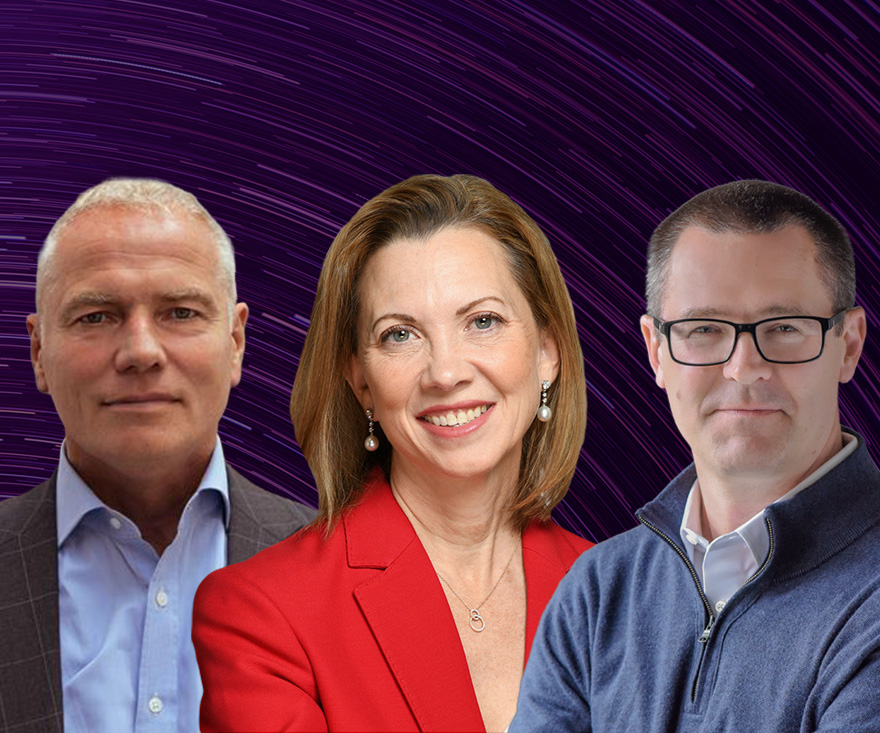
Hiten Patel: First, welcome. Great to see so many familiar faces. This is our third version of doing this. There are many familiar faces, many old guests, on the traditional version of the show. There are some new faces here, so it's probably worth just setting the scene. This is meant to be pretty informal, stripped back, laid back. You've had all the formalities of the conference over the last couple of days.
We try and get a couple of folks, a couple of people to come up and have a conversation with us about what they're seeing, some reflections. We're delighted to have a great set of volunteers and panelists to come up today. So yeah, look forward to the conversations.
Just to set the scene a little bit for what kinds of conversations we're going to have. Ten years ago or so, the FIA [Futures Industry Association] conference would be very much about the futures business. That's the name on the tin, that's what it stood for. We've gone through this period now, and it's reflected in the conference, where it's great. Now, whether you're a software provider, data or technology provider, you link to the ecosystem. It's a community for everyone, but it also reflects the kind of expansion in the business models that has kind of gone on.
And with no surprise to you all, there's been a pretty noisy point in the market where some people are getting a bit hit and whacked around. Should infrastructure businesses be diversifying? What does the SaaSpocalypse [Software as a service] mean for some of the exposures? So I think we wanted to take time today to pull back, reflect a little bit on what expansion for market infrastructure means in the context of all of these dynamics.
So, without further ado, I'm going to ask our first guest to come up. Some of you will know it's Carsten Kengeter who's now at 7RIDGE. So welcome, Carsten.
Carsten Kengeter: Thanks. Good morning.
Hiten: For those who don't know you, can you do a little brief intro?
Carsten: Yes. So, Carsten Kengeter, I ran trading businesses for most of my life, and now I'm in the investment business. And basically, the point of departure was after I left my last executive role, I decided that the depersonalization that sometimes one suffers in institutional roles was no longer for me at my age and advancing maturity. And I thought, okay, what one should do is become a steward for the ecosystem. And then we started 7RIDGE with this mission in mind.
And the mission is to focus very narrowly on trading, clearing, settlement, custody, pertinent data analytics, and B2B [Business to Business], only to find which disruptions are going to take the industry forward. And we know the continuum from innovation to industrialization is a difficult one to understand at times. And you've just talked about AI [Artificial Intelligence] or the effects of it. And we are trying to just help this group and the broader ecosystem to come to grips with what we need to reform for a better financial markets infrastructure that has more stability, more efficacy, more efficiency to avoid a 2008 happening again.
Hiten: Super. One of the things we wanted to explore a little bit was, for those of you who have had the experience of living in the exchange world, in an adjacent on the investment side, what are some of the key commonalities or key differences when you're kind of crossing some of those thresholds and going outside the pure regulated perimeter of infrastructure, but very, very close first cousin nearby?
Carsten: Technology has become more central over time across all these businesses. When Harriet and I worked on the trading floor together, it was basically a low-tech environment, and you were doing your structuring role or whatever the hell it is that you were doing with an HP 12C [refers to a financial calculator], and that was kind of it. But now, everything has to be scaled much faster. Everything has to be deliverable or mass, otherwise it's not going to make any impact on either the top or bottom line. And I think that has given an advantage to the bigger players who have a certain either oligopolistic or perhaps even monopolistic position.
However, what happens is that you become dumb, fat and happy if you are in that position. The innovators like Kelly from Chata [Kelly Cherniwchan, CEO of Chata.ai] over here, they come in, they do something afresh, and I think you need that. And so, for example, in Kelly's case, we all talk about the AI bubble and the big disruptions and that Claude 4.6 was written by Claude 4.5 and all of that. And we are completely blown away by this.
Kelly's done something very simple, among other things. He's not using GPUs [Graphics Processing Units], he's using CPUs [Central Processing Units]. He's basically, I'm simplifying this a bit, but the cost at which he's operating is probably 150th compared to the big AI scalers. So, it's a different approach. And I think what this ecosystem does, and people like Dan, who runs a big institution, what he needs as well, is the innovators in the smaller step change activity to be working with you.
And you need to be humble enough as a big institution to accept that and also see their success and cheer for them. And at the same time, the small innovators must be, I think, self-aware enough to know that the big guys will always eat them if they step out of line.
Hiten: Very nice framing. Very nice row. I don't know who's bigger, Dan or Carsten, who's doing the eating. Well, we can sort that out later. There's been like endless substacks, LinkedIn posts about SaaSpocalypse and AI. The thing that piques me a little bit in it, a lot of people are writing opinions on the impact on capital markets who are not really native to capital markets. Your take on this cast and now that you sit on the, you've gone a bit west coast now in your new role, so you've had both.
Carsten: I look at the part.
Hiten: Indeed. What do you think is missing in the discourse or being overlooked when you think about the implications and the change that is coming?
Carsten: Well, I think it's really nothing new to what we all know. The road to character is an arduous one. And if you are trying to make a lot of money by buying non-descript, non- USP'd [Unique Selling Proposition] software businesses and leveraging them up, I'm afraid you're going to be disappointed. That's not going to be something that has any lasting, sustained value. AI has devalued the product. It has, I think, devalued the path towards the product, but it has revalued in all likelihood the true sustained USP and moat of a real concept advantage along the value chain, and also it has revalued the existence and the true nature of a network effect.
So we just need to kind of rethink a little bit. I think the guy who was doing that thing, “Napalm in the morning”, he just passed away, right? I forget his name now [Robert Duvall], but the apocalypse is not going to be ... The four riders are not coming. I think it's fine.
Hiten: And I'm not sure how you're going to go with this question, but imagine putting yourself in our shoes, Carsten. So, imagine for a moment you end up as a management consultant advising the industry. Put it into context, there's been this whole diversification for a period, right? Where all of the exchanges have pushed themselves into software, data and technology.
It's now been relooked at. Your guidance for the industry around, should there be retrenchments, go back to core infrastructure? Should they still carry on as you're doing? What would your advice be to the industry as they now re-examine that kind of theory that's held for the past decade?
Carsten: So, Francis Bacon's “Knowledge Is Power” is, I think, the key to this. Oliver Wyman has built its franchise less on repeatable kinds of strategy standards and strategy paradigms and much more on sector knowledge and a deep understanding of how things work. So, I would give that advice to everyone, and that's why you are successful as a leading consulting firm. I think the big organizations must go deeper rather than broader.
I think there is a lot. It's just like when you meet someone at a party, you're more impressed with the profound character than the superficial one. And I think it's the same in business. You need to go deep and figure out how to add real, real, real value. This kind of wishy-washy, non-descript, generalist software b*llshit is just not cutting it anymore.
Hiten: Super. Very clear. Last personal question, if I may. You've had an amazing career. I'm not going to recount how many years and age, but you've had an amazing career, done many things. If you could do it all again, knowing what you know now and how things pan out and how things play out, anything you'd have done differently?
Carsten: Reviewing and revising one's judgment along the path to find where you stand in the universe is very important. When we are going through a technological period, a kind of analogy would be the Renaissance. In the early Renaissance, you had the superstars of Leonardo and Michelangelo and so on. And then later, you had the rebels like a Caravaggio, and he was equally important overall, but I think he died very young in a duel because he was unstable. I'm not drawing a direct parallel to myself, but.
Hiten: I was wondering where you were going with this.
Carsten: But I think stability and looking at where everything else around you is moving is something that we forget or that I certainly forgot because I was too personally and too emotionally invested in the various jobs that I had. And that is an important thing to do, but if you do too much of it, you forget what everyone else is doing, and you might lose out on the benefit of the community. And I think the 7RIDGE journey that I'm on now is all about the community. And I think that is something that I should have done a lot earlier.
Hiten: Thank you for the very poignant reflections. I am going to do my best Jonathan Ross impression and ask you to just shuffle one seat down if that's okay, Carsten. Quick run of applause for Carsten.
Carsten: Thank you.
Hiten: And our next guest, please welcome Andrea Stone. Again, Andrea, I'm sure many in the room know you, but a brief intro for those who don't.
Andrea Stone: Sure. So, I'm Andrea Stone. I spent the last 30 years in data and analytics. At one point in time, right after the vocal rule went into effect, I was the chief strategy officer at Bloomberg, then spent time in a similar role at ION and Dealogic, and had the good fortune to be the successor to the CEO at Refinitiv and run the data and analytics division at LSEG [London Stock Exchange Group]. And now I am the CEO of ZEMA Global.
I also sit on the board of Expansive, which is an environmental market infrastructure for environmental commodities. And I sit on the board of PEI [Private Equity International], which is the largest insight community for infrastructure and real asset investors.
Hiten: Quite the portfolio. Congratulations.
Andrea: I'm having a lot of fun.
Hiten: So, similar line of questioning for you. Given you've lived in and out of the regulated exchange world, you've been in some of the biggest public, what we call a public FITS [financial infrastructure, technology and services] players in those organizations. You're now in the smaller, more innovative, faster-growing areas. What are the similarities or differences when you compare the seats you've sat in?
Andrea: Sure. So, my first Boca was in 2012, and at Bloomberg at the time, the theme then was SaaS. It was all about SaaS. So, we actually plotted on a graph. We looked at liquidity, standardization of contracts and the number of participants, and we were trying to figure out the rate of electronification across markets. What I see now in the energy market is that you add three more factors in.
You add in the factor that it is physical and geographic. You add in storage. Storage impacts duration. And then you add in the fact that you're looking at fungibility of assets. So, it's infinitely more complex, but the march is the same. The march is from OTC [over-the-counter], to forwards, to futures. And as you go from the march from OTC to forwards to futures, the technology stack changes. The beauty, which Carsten was mentioning, is that the friction now to innovate in that technology stack is much cheaper, faster, and easier.
And what I see in the energy space is the application of a lot of what we've done over the years, much faster. So, for example, at Expansive, Expansive is aggregating retail rec credits. That's no different from the bond desk back in the day. Payment for order flow is no different from demand response, which is what Google is doing to basically pay people not to be on the grid so that they can manage the capacity. So, there are a lot of similar market structure parallels, and I think we're going to see the financialization of very complex derivatives and energies take off, and it could be an asset class that is eventually as big as what you see in fixed income.
The other thing I would say in terms of differences, I like talking to people about VAR [Value-added reseller] versus VAR, right? So, we all know what VAR is, but VAR in the energy space, voltage ampere reactor factor, but it is a measure of balance.
So, when you look at a sector that requires that makes it even more complex, but not impossible. So, I think when you look at the VAR versus the VAR world, the rate of pace of financialization in energy has been pretty slow, but it's accelerating much faster now.
Hiten: Super. Thank you. And given you've lived through some of those chapters of fixed income change, you're right at the heart of the commodities that change. I agree, there are lots of people talking to us now about commodities being great, great, great interest. What do you think is kind of missing or maybe overlooked when people think, okay, I want to go there, I want to play there?
There's a big asset class, there is a big pool, whether you're a traditional or an incumbent. What are some of the nuances or the details that you think kind of get overlooked so that people can be a bit more thoughtful about how this all plays out?
Andrea: We have a velocity mismatch, right? The grid functions in microseconds. The derivative contracts around that are in, if you're lucky, days, weeks, months, and you have because of the factor with capital investment. You have very esoteric swap contracts, bilateral swap contracts that can be 15 to 25 years in duration. Nobody really understands the volume of the underlying, and often it's dislocated from the underlying in power purchase agreements, LNG [Liquefied Natural Gas] sale purchase agreements.
This is a big mountain of derivatives that's out there. So, when you look at the timing, we're going to be entering a space in energy where the data infrastructure becomes increasingly more real-time. Curves will become more dynamic. You will start to see vault surfaces, which is something we all need. That then changes how you look at risk. So, for example, risk in the energy space, because the data's been complex and because we haven't had the compute, it's deterministic.
You've got millions of data points that you're trying to align and synchronize with pricing that is happening at a much slower snapshot, right? That is a real challenge. So, you have to put those things together and then try to figure out what your risk is. A lot of the energy companies that I spend a lot of time with now use deterministic risk models. That doesn't work. Look at the world we're living in now, right? What's happening every morning when you wake up?
The way that we're getting data is more complex than ever before. So just this morning, we all heard about the oil reserves that are going to be like 300 to 400 million barrels. The way that people are estimating how much China has is Kairos, which is a satellite company, is measuring what's on the tankers, right? They think it's 1.4 million barrels, but nobody really knows, right?
Nobody really knows. And one of the most important things that's happening in energy is that there's been a belief for a long time because of this deterministic modeling dilemma. You can hedge the short end of the curve, what they call the weather window, and you can't really hedge the long term, right? It's more about the cost of capital. In the middle of the curve, it's very hard.
People feel there aren't enough financial instruments to manage that. I think that is a mistake. I think we will see the curve eventually converge, and you will see much more dynamic hedging in the short-term. And we're going to talk a little bit about that time velocity mismatch. And I think you will start to see more innovation in financial contracts that will help hedge over that middle part, a tenor of the curve. So, I think that's what's going to be evolving, and I think it will create a lot of opportunity and a lot of risk.
Hiten: Feels like a little bit of history repeating itself with some of the different market structure changes we've seen. AI, LLMs [large language models] friend offer in the commodities data space.
Andrea: So, I think it's an enabling technology. We've had a gross overreaction in the market. At the end of the day, and particularly in our industry, sources of record are incredibly important. People overlook the importance of trust and governance. So, particularly in the energy space, and a lot of what we do at ZEMA, governance auditability is incredibly important for mission-critical decisions upon which a lot of capital rests. So, what energy firms have done is that some of them try to create their curves in the cloud or using AI, and they have a saying that they want their business users, the traders, the schedulers, the operators, to use but not abuse their curves.
Well, why? The time of day and the physical location, and the weather really matter in the short term; you're also hedging capital over five to ten years. If you think about LNG, everybody thought we were going to have an LNG glut next year, right?
They can't build the plants fast enough. So how do you? You have to have the right curve at the right time in the right system, and then you have to be able to replay the tape to be able to explain how you made the decision that you did. Utilities are highly regulated. So they often, if there's a price differential, they're going to have to report back in a 15-minute window in some parts of the country in the US, less so in Europe, though I think that's going to change now with 15-minute and five-minute trading.
That is a really important driver of having really good data governance. You cannot use generative AI unless you have a clean data foundation. That's step number one. Step number two is that you really have to make sure that you can replay the tape and that you are repeating the same fact pattern to justify the decision you made.
Generative AI is the latest version of AI. We've got AI embedded into our products at ZEMA. That's the reason why we're able to do probabilistic risk, but there are different flavors of what AI is. It's been around for a long time. Machine learning has evolved into this. I think we need to be more nuanced around how we're using it. And I think that in particularly vertically specific industries like this one, I think we're going to use this as an enabling factor for greater efficiency and to reduce the friction to get some of the transparency we need to innovate.
Hiten: It's a nice articulation of the moment, and it feels like there's a lot of common DNA annulments to some of the core infrastructure businesses that have already been established. It's your turn to get to be the management consultant; you've become part of the team. Your view on some of the exchange and infrastructure businesses around expansion, retrenchment, if they're going to expand, what are the areas, given the chats we're entering into next?
Andrea: So, I think there would definitely be a deepening. I think that was a really great point. I think that data and analytics will be increasingly deployed to create more proprietary views and infrastructure workflows in this space. So, I often talk about data exhaust. A lot of people always raise their. Give me a little frown. What the heck is data exhaust? When you look at workflow systems, right?
Workflow systems connect pieces of an end-to-end process. The data that comes from a workflow solution is exceptionally valuable. So, if you can get that exhaust and then couple that with other data sets, the ability for FMI [Financial Market Infrastructure] providers to continue innovating and providing more of the transparency that really supports the capital markets, I think that is a huge opportunity.
I also think that physical and real assets are the next frontier. I obviously wouldn't be at Zema Global if I didn't think that, but I really think that where you see illiquid markets that are not transparent, that lack that transparency, the same infrastructure that we have in technology and data and analytics can be applied to those markets.
So, if you think about it, in the '80s, oil was financialized, LNG and coal were fungible, power was not, right? Power has to flow from one place to another, but there's so much financial innovation in contracts and in market structure players, which we're going to hear from Sam next. I think that is the next frontier. And I think that we will find there's incredible money to be made because so much capital is swarming towards infrastructure and energy.
I often talk about a Troyka of energy, technology, and financial services. And I talk about three things. One, complexity crisis. The data complexity and energy far exceed anything that we see in financial services due to a lack of standardization, using observable data like sensors and drones, which is basically real-time data that you have to then normalize with non-real-time data. It's new financial securities, new asset classes.
It's complex and rich. We love that. Our industry loves that. That's where we excel. The problem we have is a competency problem. In energy companies, utilities and corporates, you do not have the trading sophistication to understand how to hedge risk. This is happening at the same time we have a pace problem. We cannot build our way out of the energy problem that we have. One gigawatt powers 300,000 homes, right?
China adds one gigawatt every 18 months. We are in a race in the US to add gigawatts as fast as we can. And the answer is, I wrote a paper last year that was talking about the shift from energy transition to energy security being the driving factor of this market. We cannot build our way out of this fast enough because of the time it takes and the capital that it takes. Renewables, you can build in two to five years.
Gas plants, you're looking at 10-15 years, off-take facilities. It's very, very capital-intensive, which is why we have these esoteric OTC bilateral swaps, and it's why new capital, new private credit, new infrastructure investors with a different risk tolerance are swarming to invest in the cables, the fibers that we saw back in 2001. This is a credit and equity crisis. So, part of what motivated me to create ZEMA is a lot of what you're seeing.
I am a little worried that we're looking at not only a potential 2008 event, but also a 2001 event, because it's both equity and credit that are being exposed in this massive infrastructure build-out that is going to create a ton of financial innovation and securities. So, you see this financial. What I love about the financial industry, we're kind of like a virus, right? We evolve, but we want to make sure the host is healthy enough that we stay alive as long as we can.
So, I think we're going to see a lot of financial innovation. The banks are all getting back into physical commodity trading, as are the hedge funds. And you're just seeing a lot of interest because there's going to be a lot of volume. And when you couple that with a lot of demand concentrated in six players in the US equity market who then are funding this infrastructure build out in creative ways that are behind the meter, behind the regulators, like I really hope that our responsibility as an industry is to provide that transparency, liquidity, and the responsibilities we have to make sure that we don't create another crisis like the one we've all been through many times.
Hiten: You paint a beautiful picture there. A little scary. Including the viruses as well. Final personal question for you as well, Andrea. So you get to rewind the clock, everything you've achieved and done in your career, you get to rewind the clock. Anything you do differently, knowing how everything plays out?
Andrea: So, one of the things I really wanted to do in 2012 is, I wanted to combine primary market issuance with secondary markets and fixed income. I wanted to buy Ipreo for Bloomberg because I always felt that what you see in the secondary market is the tip of the iceberg for what's really going on in the primary market. Inventory location and understanding what the basis of the underlying is, and how the derivatives are written against that. To me, that is the source of a lot of the risk that we have and opportunity in this industry.
So that is one thing that I really wish could have happened. It's even worse in the energy space in terms of whether it is PPAs [Power Purchase Agreement], virtual PPAs, the number of agreements, they're all written by brokers and banks, and it's incredibly untransparent. You can't see anything. It's very opaque. So that is the one thing I would have liked to have done from a market structure perspective.
To be honest with you, I am super excited about where I think we're going because I said to someone in government that I think the price of energy and the price of data will become indistinguishable. The amount of friction that you have in building the technology, particularly the data and analytics infrastructure, it is becoming so accessible that I think that this coupling of these three industries is both a risk and an opportunity.
We're seeing cross asset linking across interest rates, FX [Foreign Exchange], credit, the fuel mix, power, it's across sectors. Everything is so greatly linked. I think we're living in a time of the law of accelerating returns, where the rate of change is changing exponentially. So, when you couple all those things together, and you look at what we've learned over the fixed income electronification journey, I think it's going to happen faster now.
Look at what it took for bond trading to become electronic. It was when the traders stepped away from their desks, and they couldn't communicate and transfer information effectively during COVID, that all of a sudden, we saw electronification take off. It was there for 10 years before that. We are creatures of habit. We are very much creatures of habit. I live in Denver, Colorado, and we've had no snow this year. And as I'm driving around, I think to myself, "Oh, weather derivatives. Man, did any of them write weather derivatives? How are they going to deal with this because nobody bought ski passes?"
And then you think about water, and you're like, "Huh, is the Colorado Basin going to develop water derivatives the way that they have in Australia?", which by the way, our exchange traded. It's all possible because the technology, the data, the analytics and the market structure — the patterns are there.
It's just a matter of getting the right participants around the table to put the liquidity, participation, and standardization in place.
Hiten: Feels like there's a beautiful healing moment coming in your career, Andrea, where everything you learn in that fixed income decade, you get to play through and do next in the commodities.
Andrea: God, I hope so.
Hiten: Super. Round of applause, please, for Andrea. The final guest is Sam Tegel. Welcome, Sam. So, for those who don't know you, Sam, a brief introduction to yourself.
Sam Tegel: Sam Tegel, 25 years in high-frequency trading in markets. I will tell you what I'm doing next, but Andrea already did a great job. But I started my career in equity markets, really deep market structure, high frequency, high volume trader, moved into FX, moved into fixed income, and now I've moved into commodities. And I kind of tell the joke often, and I think Andrea would agree that equities are the most advanced market, perfectly efficient. FX is about 10 years behind that. Fixed income is about 10 years behind FX, and power is like 25 years behind fixed rates.
So, I started ElectronX about three years ago. ElectronX is a new DCM [Debt Capital Markets] and DCO [Dynamic Creative Optimization] for short-term power trading. So, a lot of rhymes there. I was looking for an opportunity to build something impactful with all the market structure learnings over the years in this market, and the innovation and kind of bring technology, meritocracy, open access to markets, really good things happen, and I want to tackle a big problem.
And so, we just launched this market a month ago in the ERCOT [Electric Reliability Council of Texas] market with the Texas market, and then we'll be in all the markets throughout this year. A little bit on the backing, we're backed by venture capital, and some big energy companies and some big trading companies. We're a team of about 35 people based in Chicago and New York. And yeah, it's a bit about me.
Hiten: And similar line of questioning, so what is it about this market structure that you're focusing on working on that has the common elements of the established markets that are present here in the conference? What is it that's allowing you and others to feel like, "Hey, this is an area we should foray into and play to. This should fit in the parameter expansion. It's behind the moat." What are the similarities?
Sam: Yeah. I think the why now is the catalyst on the supply side and the demand side in power that has caused so much disruption. Renewables are fantastic, but they cause a lot of intraday volatility that didn't really exist before. So, the opportunity was to bring shorter-term trading and my DNA to the space, which is more timely on the supply side. And on the demand side, you have the data center AI explosion driving demand growth for the first time in a long time.
So, I echo what Andrea said about the kind of people in the space. The space was kind of ossified for a long time because power demand didn't really go anywhere. And now you have catalysts on both sides. So, I think there'll be a lot of new talent. And I've been really impressed with the people I've met across the industry, innovating in the space.
There are a lot of innovators from the physical world and the market world coming into the sector. So it's just a really exciting time.
Hiten: And I guess, is there exposure from the LMs and the AI? It feels like the physical world, we're hearing you and Andrea both speak, this is a different basis that drives the innovation and the change here. What would you want the layman out there to understand about what's going on in this market and what is actually truly driving the innovation? And then, should it or should it not be pulled into the orbit of all these other LLM-type conversations?
Sam: I think the biggest thing from our industry is that the demand growth driven by AI is the biggest impact we see. And I think that Andrea mentioned this, too. It's the people who want the power now, but this is a physical build. There's transmission and permitting, and people and metal that have to be put in the ground. So it's not immediate. We see a lot more corporations looking at power as more of an asset class to trade around.
So people build these plants, and I think right now it's a rush just to get things in the ground, but over time, more players will want access to this market. So we see it as a big driver of demand for us. So part of our market structure is we're a direct market access model. So we don't have intermediation now, we'll add that, but we allow anyone to connect directly.
So, small and large players across the space, innovators across batteries, wind, solar, retail, energy and some of the demand response programs can all come to our market. I would say that's part of it. And then the other piece is just, I think that the AI, it presents a very challenging situation for lawmakers right now. Lawmakers want this built in their district for the economic benefit, but they're worried about retail rates. And so, we think that what we're building is going to do our small part to rationalize those prices and hopefully reduce volatility for retail.
Hiten: Everyone else, I wound the clock back. I'm going to wind the clock forward for you. Five years down the line, when you've fulfilled the mission that you're on, what does the market structure look like? Paint the picture. Who owns you, or where do you live in the group, right? Where will you live in the world in five years?
Sam: We'll see. There's a long way to go for that. I want to bring along the modern markets’ liquidity to the space. And I think that as new liquidity comes into the space, a lot more things can happen. The power incumbents are the power incumbents, and they're great, and they'll continue to grow, but when we bring more modern quantitative models that can price many, many thousands of instruments and get to that level of granularity, it unlocks a ton of value for the whole ecosystem. And I'm very aligned with Andrea's views on that.
Hiten: Thank you so much for coming out. Thank you for being so generous with your thoughts to be so candid. So, thank you for making the conversation.
This transcript was edited for clarity.