

Payments are evolving quickly, but many merchants are still balancing tomorrow’s opportunities with today’s operational demands. Digital wallets are becoming more entrenched, new technologies such as AI, agentic commerce, and stablecoin are attracting attention, and customer expectations continue to shift. Yet payments teams remain heavily focused on managing core operations, fraud, and chargebacks, leaving less time for strategy, optimization, and innovation.
With that in mind, Oliver Wyman and the Merchant Advisory Group surveyed payments leaders at enterprise merchants across a host of industries on a near-yearly basis to identify key trends and their implications. This is the fourth edition of the Voice of the Merchant Study since 2022, a span that helps to shed light on long-term developments in the payments ecosystem.
This year’s research focuses on two areas. The first is merchants’ core payment operations, such as payment methods to accept, the size of their teams, their focus on day-to-day demands, and procurement strategies. Second, we look ahead at the next frontier in payments, including companies’ adoption of AI within payments teams, forays into agentic commerce, and interest in stablecoin. The results provide both an instructive snapshot of the current landscape and an eye-opening forecast of what lies ahead.
New payment methods gain ground as core demands persist
Merchants indicated that traditional non-cash consumer payment methods still dominate the sales mix, making up 67% of consumer payment volume. However, alternative payment methods — including co-branded cards, pay-by-bank, buy-now-pay-later, closed-loop wallet, and real-time payments — are making inroads in specialty retail and other verticals. Further, Apple Pay and Google Pay are now accepted almost as widely as credit cards, driven by consumer demand for fast, secure omnichannel experiences. In our survey, 89% of respondents said they expect usage of these digital wallets to stay the same or increase in 2027.
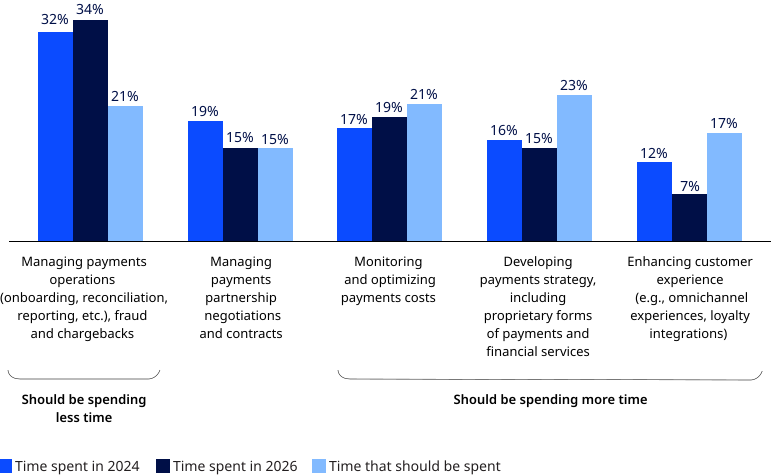
Capacity demands have largely remained the same over the years, a finding that highlights one of the intractable issues merchants have long faced: the struggle to address strategic concerns while also handling the requirements of other day-to-day work.
Survey respondents reported spending 34% of their time on managing payments operations (such as onboarding and reporting), fraud, and chargebacks. That’s roughly the same as in 2024, when, on average, they said they should be spending just 21% of their time on those tasks. Conversely, there are several activities on which merchants are not spending as much time as they’d like, including monitoring and optimizing payment costs, developing a payment strategy, and enhancing customer experience. As a result, many respondents are strategically leveraging third parties to manage more complex aspects of payments operations.
AI agents and agent-driven commerce struggle with merchant adoption
The next frontiers in the payments space appear to hold considerable promise, but for the most part, merchants aren’t yet trying to cash in. The survey found that 54% of internal payments teams are not using quantitative AI solutions, and among those, 53% have no plans to do so. Similarly, 60% of teams are not currently using generative AI, viewing its value as limited.
Smaller merchants that generally have fewer payment resources are more likely to view generative AI as having higher potential value as they look for ways to stretch productivity. Merchants that have adopted the technology are focusing mainly on fraud detection and cost optimization, indicating that AI is most attractive where it can drive bottom-line efficiency and reduce risk.
The excitement over agentic commerce has not yet translated into tangible retail momentum. An overwhelming 84% of merchants say they have not had any customer demand for agentic commerce. As a result, they are still in wait-and-see mode — tech-oriented and retail merchants are the furthest along, but only 6% of all survey respondents say agentic commerce is an area where they want to be leading.
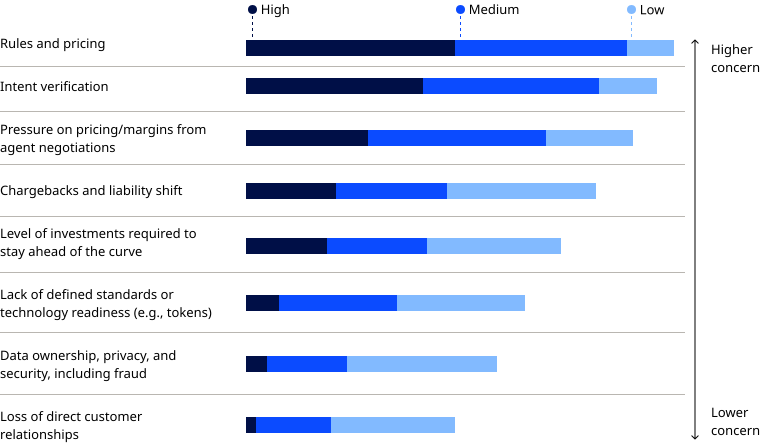
Reflecting that cautious mindset, merchants’ payments teams say that as agentic commerce matures, they would prefer to minimize integration costs and complexity by adopting AI shopping agents that require less customization and maintenance. Even if they embrace the use of agents, however, widespread adoption hinges on merchants’ ability to overcome a range of challenges. Their greatest concerns are around rules and pricing, intent verification, and investment costs.
Why stablecoin is winning merchant interest but losing on adoption
Stablecoin also makes the list of payment innovations whose time has yet to come. None of our survey respondents accept them, and most (51%) have no plans to. And, as with agentic commerce, stablecoin won’t reach a critical mass of acceptance before meeting several conditions, chief among them demonstrable demand from customers. Eventually, though — whether for stablecoin or other frontier innovations — the payments environment is bound to catch up with the hype. Merchants will need to be ready.
Preparing for the next era of merchant payments
The challenge for merchants is not simply deciding which emerging technologies to adopt, but creating the capacity to act when the opportunity becomes clear. Reducing the operational burden on payments teams can free up time for strategy, optimization, and innovation. As digital wallets mature and AI, agentic commerce, and stablecoins evolve, merchants that strengthen their payments foundations today will be better positioned to respond to changing customer demand tomorrow.