


The irony about technology transformations: They rarely fail because of the technology. What trips up major efforts to make over an organization’s technology infrastructure most often is an inappropriate operating model and a combination of inadequate planning, insufficient sponsorship and funding, and a misaligned workforce lacking the skillsets necessary.
The situation facing agentic AI is no different. What makes it more treacherous for IT functions is agentic’s clock speed and its ability to produce code at a pace that threatens to compound any initial wrong turns companies make. With agentic AI, when the IT operating model is weak, quality and stability go down as usage goes up.
Managing that risk comes down to adequate preparation before agentic AI is fully unleashed.
For CIOs and CTOs preparing their organizations for agentic AI, three interconnected priorities demand attention: rethinking IT delivery, preparing applications and workforces, and strengthening AI governance and funding. The challenge is bringing these priorities together into a coordinated transformation that delivers measurable business value.
How to lead an enterprise-wide agentic AI transformation
Turning these priorities into action starts with three questions: Does or will your agentic program run on a fixed delivery cadence? Does a transformation office exist that is able to challenge the overall business case? Is there a live risk-tracking matrix?
All three exist in 45% of organizations with agents in production. In organizations with agents still in pilots, the figure is 3%.
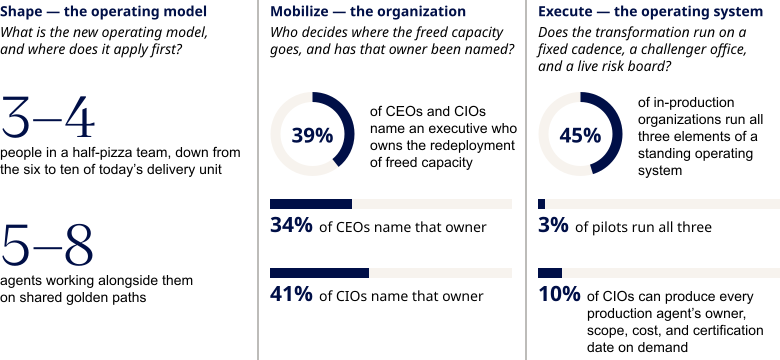
When an organization buys agentic capability and expects teams to adopt it, the result will be usage, not transformation. Agents enable faster autocomplete, while the work itself stays unchanged. Achieving meaningful transformation requires three connected moves:
Shape the operating model: Establish shared golden paths, segmentation by value and readiness, two or three priority domains, and define an explicit sourcing model, especially where delivery capacity sits outside the organization and is priced by headcount or time.
Mobilize the organization: Show working output, build individual fluency, engage middle management early, and fund the near-term productivity dip.
Execute in three-to-six-month phases, or seasons: Start each phase with clear direction from the top and end with a scored review against a measured baseline.
Two decisions must involve other members of the C-suite besides the CIO. First, the CEO must sustain sponsorship through an initial productivity dip, which typically follows the introduction of agentic AI as teams rework processes and learn the tools.
If an agentic program loses sponsorship because of the dip, it risks failing to realize the expected returns. Half of CEOs (51%) have funded the dip but failed to secure sponsorship for the full cycle. The CFO and CIO must agree, before the first season ends, where released capacity will be reinvested.
Why smaller IT teams require a new agentic AI operating model
The test for the largest agentic use cases: Can finance show the gross time saved, the extra review and run costs, the capacity released, and where it went? In 39% of CEO and CIO responses, a named executive owns the redeployment of that capacity, but for the rest no one is named as accountable.
Redeploying capacity is only part of the challenge. Agentic AI is also changing how IT teams are structured. Agents shrink the delivery unit to a pod of three or four experienced people who direct a much larger set of agents. That shifts the burden onto the organization around the pod.
If a small team lacks clear interfaces and a shared platform, it must rebuild the support the bigger team used to provide on its own. A pod that can test a change in hours but then must wait 10 days for an architecture decision has not removed the bottleneck. It has simply moved it.
We recommend moving toward a federated “platform model.” In this new IT environment, domain teams made up primarily of experienced professionals own outcomes and day-to-day decisions. Shared platform teams provide the tools and paths for the domain teams to build on and run as internal products. Assurance can halt a release, a reliability team owns what happens at 3 am, and a single portfolio body can move capital and capacity across domains.
While there are fewer human bodies, IT relies on agents to provide new capacity. But IT must grapple with how that new capacity will be used to avoid losing the potential value from it. That’s why it is vital for CIOs to decide where the capacity could provide the most value — whether through growth, better quality and resilience, previously unmet demand, or cost savings.
Another challenge is protecting the junior talent pipeline as teams become more senior: Today’s juniors are tomorrow’s senior engineers. Redesign roles and the pipeline before any headcount decision.
Finally, CIOs should be reopening any outside vendor contracts that are still billed based on headcount. Otherwise, the vendor may end up pocketing the savings generated by agent capacity.
What 200 CEOs and CIOs think about the agentic AI transformation
In 2026, Oliver Wyman conducted surveys of 130 CIOs and CTOs and 70 CEOs. On productivity, the two groups are close. Eighty-five percent of CIOs and CTOs have measured gains of 20% or less on their own delivery pipeline, while 64% of CEOs look for gains between 11% and 20% across the organization over the next two to three years. Both were an order of magnitude below the headline claims of vendors.
Yet the funding often fell short of top management’s aspirations for agentic. Almost half of the CIOs (48%) said current funding would only deliver gains between 1% and 10%. Only 8% described funding as sufficient to reach 20% or more. This misalignment between ambitions and investment helps explain why agentic AI may be failing so far to live up to its hype.
CEOs were also failing to ring-fence money that the platforms, data, and change work agents depend on, with only 29% saying they had. While six out of 10 had upped overall AI spending, most had done so without designating its use.
What derails IT transformations needed for agentic AI
This kind of gap between what is needed and what is happening usually resolves itself in one of two ways: Either the ambition comes down, or the program is cut during the early, painful dip. At that point, it is often written off before it has a chance to demonstrate its potential.
There is also a wide gap between what pilots have put in place and what scaled programs have built. Among CIOs still piloting an agentic rollout, only 4% said they could provide, on demand, each agent’s owner, scope, cost, and last certification date. Among those with scaled agents, that figure rises to 38%.
Accountability is built on the way to scale, yet many organizations remain at an early stage and may struggle to progress without showing results For instance, close to half of the tech leaders surveyed noted that little to none of the productivity gains thus far from agentic AI have reached the enterprise’s top or bottom lines as new revenue or realized savings, making it more difficult to secure funding, if needed.
Building the IT platform for agentic AI at scale
The agentic platform is not a separate product to buy: It is six capabilities the internal developer platform must add — agent identity, an agent registry, an agent gateway, per-workflow cost instrumentation, a written autonomy boundary, and review capacity that keeps pace with what agents write. These capabilities must be built in dependency order, starting with identity. Cost must be tracked from the first pilot because they cannot be reconstructed afterward.
These capabilities change the platform team’s responsibilities as well as the technology it manages.
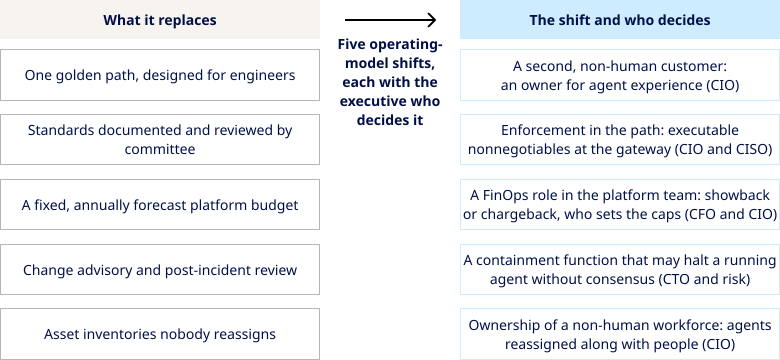
The shift most organizations underestimate is in the containment function: a team empowered to stop a running agent. The skills already exist in site reliability, security operations, and risk; what is missing is the mandate. No domain should shrink its team before the platform supporting it has been proven.
Agentic AI value starts with business process redesign
CEOs are clear about where durable advantage will come from: Almost three-quarters (74%) named reengineered processes and the operating model. As frontier models converge in capability and fall in price, the difference between two competitors is what happens inside the enterprise.
Effort on the ground is closer to the right shape than budget headlines suggest. On their largest agentic initiative, CIOs report 29% of effort was spent on data and knowledge structuring, 28% on tooling and licenses, 24% on process reengineering, and 19% on change and enablement. The binding constraint sits underneath, in the data. Eighty-three percent describe their data as governed in some domains and fragmented in others.
Agents inherit the quality of the work around them. If they are deployed into a tangled process, then the tangle will be industrialized, underlining the importance of sufficient planning, preparation, and ownership.


