


Central banks face a distinctive challenge with artificial intelligence. Their legitimacy depends on judgment, accountability, independence, and public trust, which makes the way they adopt AI especially consequential. But moving too slowly brings risks of its own, as the financial system becomes more complex, more data-intensive, and increasingly shaped by AI-enabled institutions, infrastructure, and threats.
AI matters to central banks in two ways. It is a tool they can use to strengthen macroeconomic analysis, financial supervision, payments oversight, and internal effectiveness. It is also becoming part of the system they oversee, influencing how financial institutions make decisions, how risks emerge and spread, and how markets and infrastructures behave under stress.
That dual role creates a strong case for moving beyond isolated experimentation toward value at scale. But the difficulty is deciding where to act first, not seeing the opportunity.
AI in central banking creates a farsightedness paradox
From a distance, central banks appear especially well suited to AI. They hold large data assets, perform complex analysis, monitor extensive systems, and make consequential decisions under uncertainty. AI can support data collection, validation, analysis, decision support, implementation, monitoring, communication, and institutional learning.
The challenge becomes clearer as institutions move toward implementation. The breadth of central bank mandates creates a large number of plausible AI applications. The more opportunities that become visible, the harder it becomes to determine which will create the most meaningful institutional value.
Potential applications span the central bank lifecycle, including monetary policy and macroeconomic analysis, financial stability, supervision, payments and market infrastructure, and shared institutional services. They range from nowcasting and scenario generation to anomaly detection, licensing support, market intelligence, fraud and anti-money-laundering alert triage, and resilience monitoring.
That breadth makes prioritization essential, but challenging. Central banks need to distinguish applications that are simply interesting from those that improve policy judgment or institutional effectiveness sufficiently to justify investment.
Central banks need a different framework for AI value
Where private-sector organizations can often assess AI investments through revenue growth or cost reduction, central banks cannot rely on those measures alone. The more relevant gauges are whether an application changes the quality, speed, coverage, resilience, or explainability of an activity within the central bank value chain.
Three lenses can help assess the value and feasibility of individual applications:
- Policy impact considers whether AI improves a mandate-critical decision, intervention, supervisory judgment, or resilience outcome
- Productivity impact considers whether AI makes the institution more effective through faster processes, improved services, stronger controls, or better resource allocation
- Implementation feasibility asks whether an application can be delivered safely and at scale given available data, technology, governance, skills, and operational adoption
Policy impact can be particularly difficult to measure because many benefits are indirect, preventive, and closely linked to public outcomes. To determine value, central banks may need greater willingness to work with directional or proxy-based measures where precise quantification is not possible.
Productivity benefits can often be measured more directly through staff hours saved, shorter turnaround times, reduced errors, improved consistency, greater coverage, and willingness of the organization to adopt tools that improve workflow efficiency.
AI governance for central banks must account for feasibility
High potential does not guarantee scalability. Organizational readiness, infrastructure, and delivery capacity can constrain implementation even as AI capabilities continue to advance.
Meanwhile, rising operating costs can cause hesitation on adoption, along with the significant investment in computing infrastructure, data platforms, and scarce specialist talent required. Institutional culture also may slow adoption in organizations like central banks that are built around deep expertise, rigorous analysis, and careful judgment. Other constraints for technology choices can involve questions of sovereignty, independence, security, and resilience requirements. Delivery capacity is also finite. In central banks, AI initiatives compete with broader technology, cyber, payments, and supervisory technology transformation programs for funding and skilled resources.
For that reason, prioritization should not be treated as a one-time ranking exercise. Early deployment of more feasible applications can build data assets, delivery capabilities, governance maturity, and institutional confidence. Those foundations can then make more ambitious, higher-impact applications easier to pursue.
Practical wins can create a flywheel for higher-impact AI
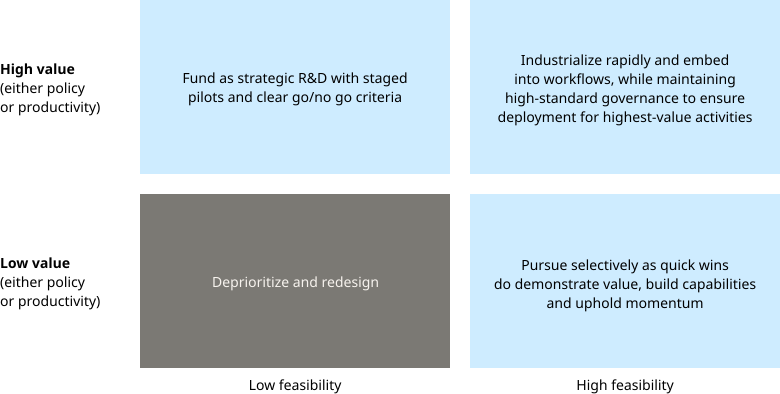
Building a value-and-feasibility matrix can help translate prioritization into portfolio choices. High-value, high-feasibility applications can be industrialized rapidly and embedded into workflows, while high-value applications with lower feasibility can be treated as strategic research and development, with staged pilots and clear go/no-go criteria. Lower-value but feasible applications may still be pursued selectively.
This approach also recognizes that policy value and productivity value need to coexist. While productivity-oriented applications may secure support more quickly because their benefits can be more immediate and measurable, policy-oriented applications with harder-to-quantify added value may be strategically more important. Over time, impact and feasibility should reinforce one another.
Practical wins can strengthen the foundations needed for more strategic applications, while strategic applications can create the case for further investment in data, governance, technology, and delivery capability.
Five imperatives can help central banks embed AI at scale
Prioritization alone is not enough. Moving from isolated pilots toward scale and sustained value requires AI to be embedded into institutional strategy and the operating model. Five imperatives can help make that transition.
First, central banks should establish central governance and clear accountability. That way standards, investment priorities, funding, ownership, and escalation mechanisms are coordinated across the institution.
Second, they should embed strong risk, ethics, and responsible AI controls. Independent validation, continuous monitoring, auditability, explainability, and human oversight need to form part of the AI lifecycle, supported by role-specific training and practical exercises.
Third, they should strengthen shared data, technology, and experimentation capabilities, including common data standards, shared data environments, model operations capabilities, and reusable AI platforms.
Fourth, they should invest in multidisciplinary talent and delivery capacity, combining policy, supervision, engineering, product management, and change expertise while making carefully governed use of external partnerships.
Fifth, they should begin with a small number of high-impact applications rather than trying to address the entire AI opportunity at once. Early progress can help build institutional confidence, refine prioritization criteria, and create momentum for broader adoption.
Ultimately, central banks need to balance long-term ambition with deliberate near-term action. A clear institutional AI ambition can serve as a North Star, while governance, capabilities, talent, and focused use cases translate that ambition into sustained progress.

