


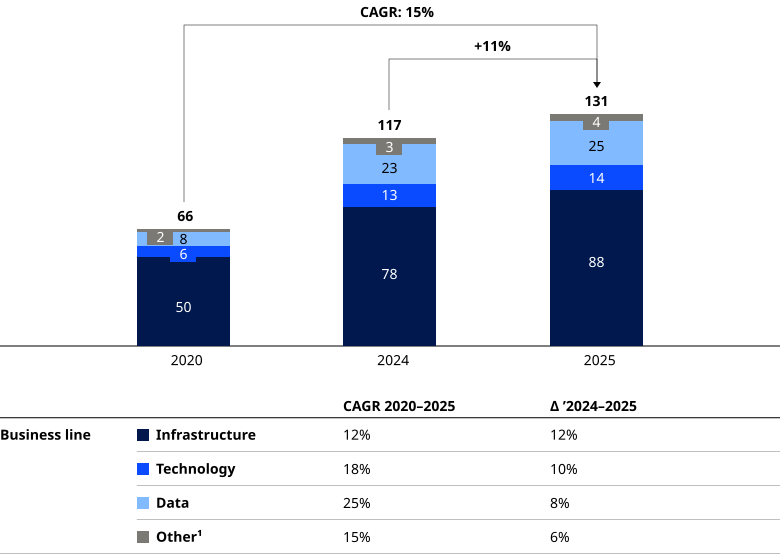
The financial market infrastructure (FMI) sector enters its next cycle larger and more diversified, but within a far more competitive landscape. While baseline revenue growth remains strong, even after expanding at approximately 15% annually between 2020 and 2025, the gap between winners and laggards is widening as the forces reshaping the industry gain momentum.
Two forces will decide which players pull ahead: enterprise artificial intelligence (AI), and the rise of new markets via tokenization and new event-based or compute-led contracts. Our Global Financial Infrastructure Report 2026: Back to the Future identifies where FMI value is most exposed, the likely opportunities, and the strategic approaches we believe will allow certain enterprises to emerge as winners over the next several years.
A defining feature for the next cycle will be a renewed focus on core infrastructure businesses, following a period marked by $88 billion in acquisitions across data and technology. In contrast to the last cycle, outperformance will depend less on diversification and more on defensibility, business mix, and execution.
Financial market infrastructure enters a larger, more competitive cycle
Two tailwinds drove the last cycle: the volatility and secular deepening of capital markets that lifted core infrastructure franchises. Secondly, more than $100 billion went toward M&A, with the bulk going to data and technology. That expanded the sector into higher-multiple, recurring revenue. Data and technology now account for 30% of sector revenue, up from 21% five years earlier. This broadened the sector’s client reach across the buy side, sell side, and corporates.
The next cycle is likely to keep much of that momentum. Sector “beta” remains attractive, given the ongoing deepening of capital markets, the need for risk management, the continued financialization and electronification of asset classes, and broader retail participation, with listed derivatives, commodities, and digital assets growing fastest.
What shifts is the “alpha.” In our base case, the sector’s revenue pool is expected to grow at a compound annual rate of 8%, versus 6% CAGR expected in our AI-headwinds scenario and 12% expected in our new markets bullish scenario. By 2030, total revenue could reach approximately $200 billion in the base case, rising to around $230 billion in the bullish scenario.
Enterprise AI is stress-testing last cycle’s M&A and revenue defensibility
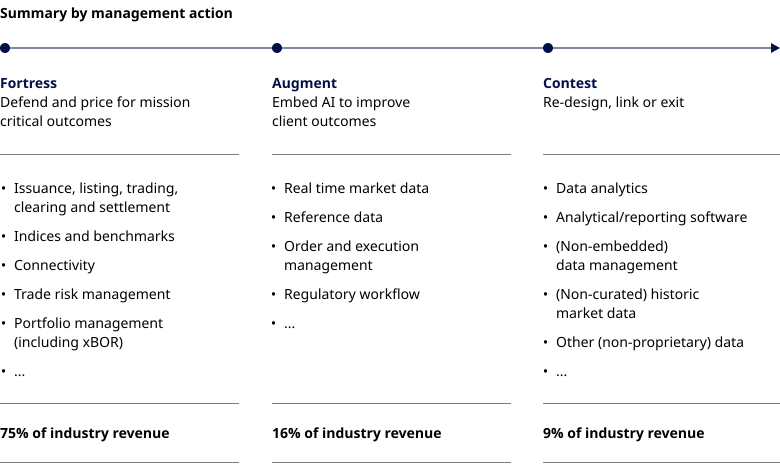
Enterprise AI raises substitutability in commoditized data, analytics, and non-embedded workflow tools. We estimate about 9% of FMI revenue, or roughly $12 billion, is at direct risk, with an additional 16%, or about $21 billion, at risk without active mitigation. The segment that remains defensible is anchored in proprietary content, authoritative records, regulatory and audit relevance, mission-critical functionality, deep client embedding, network effects, and trusted connectivity.
Scoring business lines across six dimensions, network effects, workflow embeddedness, mission-criticality, regulatory and audit role, deep proprietary IP, and trust and authority, enables revenue to be segmented into three tiers:
- Fortress (about 75%, or $97 billion) spans issuance, listing, trading, clearing, settlement, indices and benchmarks, conanectivity, and trade-risk and portfolio management. Revenue in this tier should be defended and priced for outcomes.
- Augment (about 16%, or $21 billion) encompasses real-time and reference data, order and execution management, and regulatory workflow. This tier needs embedded AI to hold value.
- Contest (about 9%, $12 billion) and includes non-differentiated analytics, non-embedded reporting, and non-proprietary data. This tier should be redesigned, linked, or exited. The implication for capital allocation should be clear: The M&A agenda shifts from buying scale to buying operationally and strategically synergistic assets that are defensible.
Where AI drives revenue growth and an EBITDA margin expansion
AI is not only a threat : it also represents a material growth opportunity . It can add roughly $9 billion of new revenue, equivalent to about 7% of 2025 sector revenue, with the new revenue concentrated in the defensible Fortress and Augment tiers.
The upside comes through three compounding levers: approximately $5 billion from new products such as AI-enhanced analytics and signals, surveillance-as-a-service, and decision support embedded in execution workflows; another $2 billion from outcome-based pricing, where the most differentiated data businesses can reprice by more than 30% like-for-like; and further $2 billion from higher usage as copilots and agents increase consumption.
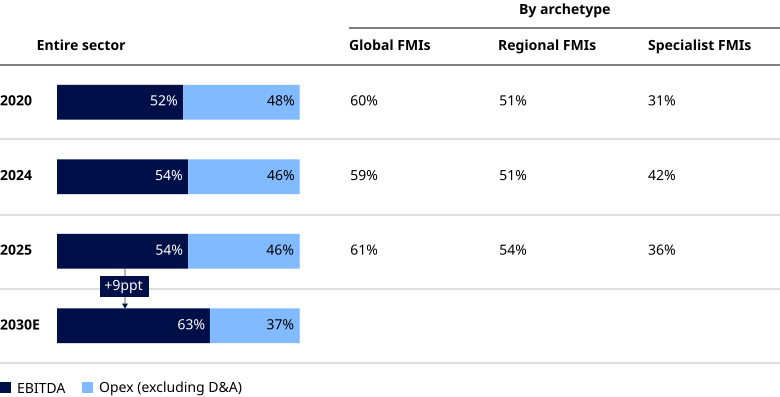
On the cost side, AI offers a cost-reduction potential above 20%, which could lift sector earnings before interest (EBITDA) margins from a stable 52–54% to more than 60%: a nine-percentage-point gain. But the value scales only when AI is industrialized through an “AI factory.” That means reusable components, shared data and feature layers, robust model-risk management, hard productivity targets, and a value control tower that prioritizes use cases and enforces reuse. If left as fragmented pilots, the prize stays out of reach.
Why AI governance must scale with autonomous AI systems
Capturing that prize safely is a governance question as much as a technology one. FMIs are moving from single-task models to integrated AI systems that can run autonomously, with risk management evolving alongside.
Testing and validation at the level of individual use cases is no longer sufficient. Instead, the entire execution trajectory must be tested and monitored at runtime, ideally at the system level, across transversal risks such as model drift, explainability, data leakage, and operational resilience.
The lines of defense will likely shift accordingly, requiring a top-of-house framework setting risk appetite and use-case classification, with first line ownership for AI outcomes, and second line ownership of the framework. When treated this way, governance is set up to enable adoption rather than constrain it.
How tokenization is reshaping post-trade infrastructure revenue
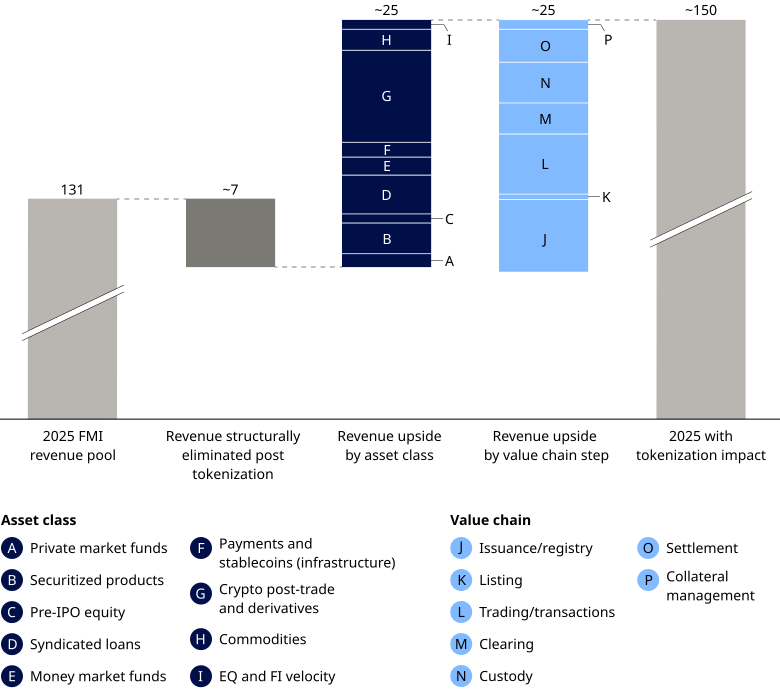
Tokenization could move as much as 35% of today’s revenue, or about $45 billion, onto new token-native rails, and structurally eliminate about 5% (around $7 billion), leaving roughly 60% (about $78 billion) untouched. The downside is sharpest where post-trade franchises potentially lose market-of-record status in issuance, registry, clearing, custody, settlement, or servicing.
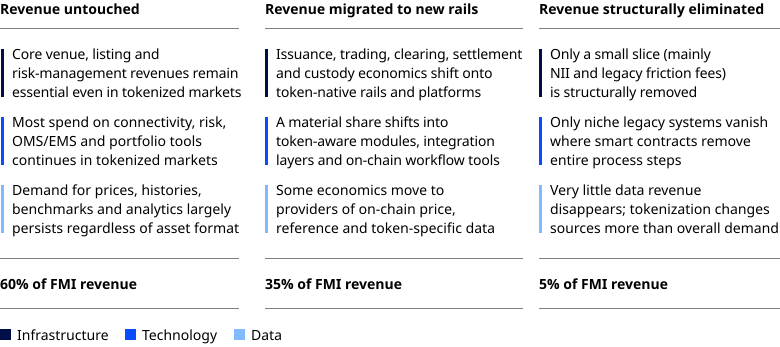
Expanding the universe of assets that institutional infrastructure can serve offers about $25 billion of gross revenue upside, outweighing the roughly $7 billion eliminated.
The clearest near-term opportunities are money market funds, crypto post-trade and derivatives, and syndicated loans, alongside higher velocity in equities and fixed income, specifically for retail and hedge fund investors. An increasingly important driver is regional and regulatory competition, as jurisdictions move to protect or repatriate clearing- and settlement-linked revenue, making sovereign and regulator partnerships a first-order issue. FMIs need to act now, as capability-building will require a multiyear journey.
Prediction markets will be the next listed-derivatives growth frontier
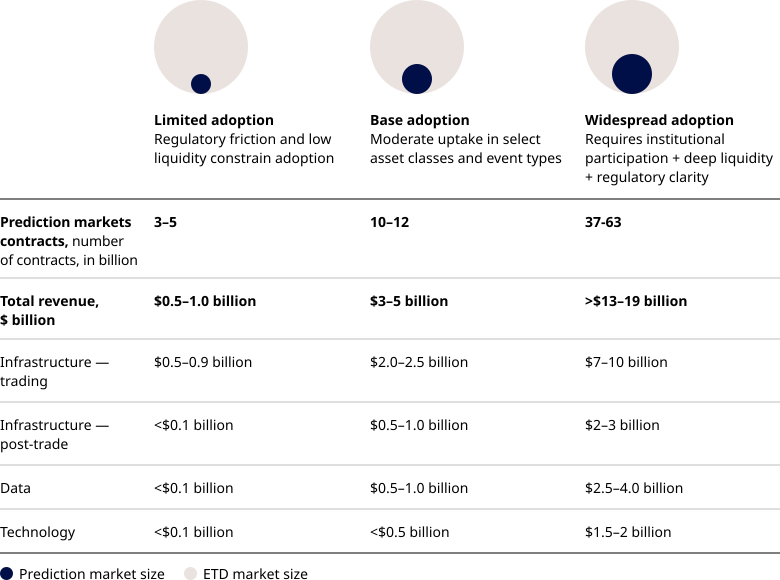
Prediction markets are the next step in listed-derivatives innovation. FMI-addressable event-risk contracts, spanning macro and policy, weather, corporate, and regulated asset-market events, could become a $3 billion to $5 billion annual revenue pool in our base case, with 60%–70% net new to the industry. Roughly half would sit outside trading in post-trade, data, and technology.
In a widespread-adoption case, the pool reaches between $13 billion and $19 billion. We estimate about 10%–15% of current exchange-traded-derivative volume could be put at risk by event contracts.
For FMIs, the hard part is not contract design but, rather, liquidity formation. That includes the distribution, incentives, and community-building that turn a listed contract into a liquid market. This is where crypto- and DeFi-native platforms have so far been more effective. Incumbents bring rulebook credibility, clearing, surveillance, and trusted event data, but it is closing the market-building gap where FMIs have the most ground to make up.
Compute is becoming a FMI asset class
The new asset class, Compute, is showing the classic hallmarks of a financializing commodity: a scarce, volatile, critical input with an existing physical marketplace priced by graphics processing unit per hour.
Data center capacity is set to nearly double from about 75 gigawatts to 140 gigawatts between 2025 and 2030, with AI’s share rising from 15% to 35%. Its nonstandard, regionally variable nature points to a fragmented market spanning over-the-counter and request-for-quote execution, listed venues, benchmarks, and post-trade services. This is an opening for regional FMIs to anchor domestically sovereign AI ecosystems by applying the lessons of commodities financialization to a new asset class. We estimate Compute markets present a $0.6-1.0 billion opportunity for FMIs.
Four strategic choices that will define FMI winners through 2030
Every senior team can see these trends. Differentiation in the next cycle comes from how clearly each FMI organizes around four strategic choices:
- Market-of-record. Winners will prioritize investments into asset classes with the highest secular growth. They will defend trusted post-trade economics as activity moves to new rails and new jurisdictions and build the institutional rails for new tokenized asset classes, event-risk markets, and other new contracts like Compute, before liquidity and data advantages lock in.
- System-of-work. Winners will defend embedded technology positions where they sit deep in client workflows, fortifying the embedding and proprietary data and repricing for value. They will build token-aware and event-risk workflow modules to capture new markets.
- Source-of-origin. Winners will defend data positions where content is proprietary, authoritative, regulatory-mandated, or embedded into client distribution. They will link exposed analytics into solutions anchored on these moats and reprice toward outcomes. Finally, they will build trusted reference, pricing, and event-data layers for tokenized asset classes and event-risk markets.
- Operating model. Winners will treat AI as an operating-model lever, industrializing an “AI factory” that converts cost reduction into EBITDA margin uplift and unlocks the AI revenue upside at scale. They will also close the market-building capability gap (organically or inorganically) relative to crypto and DeFi-native platforms and build the distribution, incentive, community, and product-launch capabilities that consistently turn new asset-class contracts into liquid markets.
On balance, the outlook is constructive, but the center of gravity is shifting. After a cycle defined by diversification into data and technology, we’re moving back to the future for the next cycle with a focus on core infrastructure. The winners will be those who defend and extend it while turning AI, tokenization, prediction markets, and compute into new infrastructure of their own.
