


Premiumization isn’t a simple strategy, but it’s a useful one that many consumer packaged goods (CPG) companies are betting on.
Facing intensifying competition and cost pressures, CPG companies are increasingly moving into premium products to differentiate themselves. Along with the vast opportunity comes significant complexity, so before moving forward, leaders need to take a holistic view of the commercial case for making the shift. That means evaluating the costs of premiumization across production, distribution and storage to determine whether — and on what scale — to pursue it.
Businesses that forge ahead will need an exhaustive, integrated effort to manage the strategy while developing a unique product assortment that’s both cost-effective and appealing to consumers.
CPG companies have already been contending with limited growth in the sector; US non-food sales, for example, grew at just a 2% rate in 2025. At the same time, upstart grocers and other innovative retailers have been launching private- label products in a host of categories.
According to the Private Label Manufacturers Association (PLMA), a nonprofit trade group, US private label revenue increased by $64.8 billion, or 30%, between 2021 and 2025. And where in the past these products were typically viewed as inferior to brand-name offerings, across industries, they’re becoming increasingly sophisticated: PLMA finds that 70% of consumers believe private-label products are of equal quality to other brands. Some private labels now offer the same or better features as brand names and even come at a lower price, increasing penetration among price-conscious customers fleeing to value.
Determining when premiumization creates more value than cost
This new environment presents a challenge for brand managers, product developers, pricing strategists, and marketing leaders considering premiumization to remain competitive. Perhaps the first step toward solving it is to identify the potential benefits of introducing greater complexity. Quantifying the upside of moving into a new demand pool, for instance, requires thoughtful and thorough analysis.
On the flip side, without a full understanding of the costs of moving into premium and the limits that must be imposed, it’s difficult to know whether the return will be worthwhile. Even before embarking on a premium strategy, companies must develop a planning process that spans departments and functions, allowing leaders to make informed decisions.
Among other thorny issues at the beginning of the process, they’ll need to weigh the trade-off between pursuing a premium brand extension and creating entirely new brands, and between launching in one category and in multiple categories. Then there are questions about which stock-keeping units (SKUs) would contribute most to growth and which value SKUs would be needed to offset customers’ price concerns. Also to be resolved is whether to build a new premium product line or buy an existing one. Again, taking a holistic view that accounts for financing, opportunity costs, and other factors is critical.
Four cost challenges every premiumization strategy must address
From the outset, a business needs to constantly consider everything that will change when they introduce premiumization into the portfolio. Deciding which products are premium and which features to include in them will have sweeping effects on operations, adding complexity.
Essentially, it’s a cost of goods sold problem — companies have to account for all relevant details to ensure their product-making costs won’t negate the premium prices. Raw materials may be more expensive, additional packaging costs can crop up, and there’s a risk of additional downtime to change product lines in manufacturing facilities. Inventory for both the CPG company and buyers will be impacted. Slotting fees for new product extensions need to be accounted for. The list goes on and on.
Calculating all these variables is a daunting challenge, to be sure. Overcoming it starts with establishing a comprehensive cost management framework that includes both commercial and operational levers. The framework should comprise robust processes that collect, prepare, and consolidate data across different groups in the company, with automated reporting and analytics to provide a detailed, end-to-end view of several key elements:
- The nuances of the company’s premium manufacturing operations, such as increased packaging costs and premium ingredients, as well as the potential downtime and training required for transitioning lines.
- The warehousing and storage issues stemming from increased manufacturing complexity — not just for the brand but also for customers, which may impact their willingness to pay.
- The logistics network, considering the potential for more split pallets and less-than-truckload transportation needs.
- The commercial implications of the company’s cost changes for its retail customers: building proper brand architecture in pricing, slotting, and the need to fund trade spend.
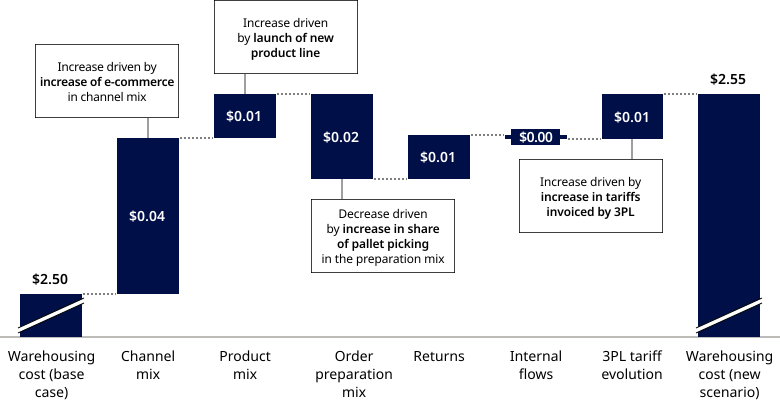
This will also include increased spending on shopper and retail marketing to build awareness of upstream products. To illustrate, in a recent engagement with a major household products company, we built a solution that provided an accurate, granular view of the client’s cost-to-serve. The project also helped generate a better understanding of the drivers of cost change — a vital piece of the larger cost puzzle the company needs to solve. The following exhibit is a deep dive from the warehouse module of the analysis:
How top brands successfully measure and win at premium strategy
Once a company has built out the technical capability to precisely measure all these costs, it can gauge how successful the effort to premiumize has been. A well-orchestrated cost management architecture will highlight shelf productivity, consumer penetration, incrementality, and other metrics. That knowledge will also serve the company well the next time it assesses its premium strategy, which in some product categories may be necessary as often as two to three times a year. When it comes to managing costs and complexity, there’s never a chance to rest.