


As 2026 opened with heightened uncertainty, the airline industry offered an early look at how carriers are adjusting to new operating realities.
Global airlines showed solid first quarter results despite a sharp increase in fuel costs and growing geopolitical uncertainty. Carriers capitalized on strong demand, resulting in improved unit revenues and higher margins.
Airlines in our global index saw worldwide capacity expand by 3.7% and revenue increased by 11.4%, enabling operating margins to improve approximately 2.0%.
In response to the conflict in the Middle East and rising fuel prices — which peaked with an 80% jump in April, carriers began removing capacity and raising ticket prices. The impact of those shifts will be clearer in the next quarter. While the forecast for fuel prices is uncertain, the IATA currently puts the average jet fuel price at $152 per barrel in 2026, an almost 70% year-over-year increase.
If fuel prices remain elevated, carriers may be forced to remove capacity more aggressively. The recent margin gains may prove difficult to sustain in an environment where pricing power weakens while operating costs remain structurally higher.
The latest edition of our Airline Economic Analysis details the industry's first quarter results and assesses the impact of the conflict in the Middle East so far.
Latin America leads global airline growth while Europe is unprofitable
Despite rising fuel costs, worldwide consumer spending rose 6.7% and airline revenue considerably outpaced GDP growth across regions. Revenue grew faster than expenses, driving an increase in margins.
European carriers had the lowest operating margin — typical during the winter months — but still demonstrated year-over-year growth. Asia/Pacific was the second most profitable region, with strong margins of 8.1% driven by increased capacity. In North America, airlines grew margins by 0.8 percentage points on 3.3% capacity growth, a smaller gain than in previous quarters.
Global capacity grew by 3.7%, largely due to a 6.8% increase in Latin America, with other regions experiencing less than 4% growth. Fleet growth drove capactiy increases in all regions.
Full-service carriers in most regions saw more margin growth than value/LCCs. In North America, FSCs posted strong, positive margins while LCCs had a collective loss. Both carrier types demonstrated positive margins in Latin America, but growth slowed for LCCs. Full-service carriers in Europe posted lower margins than value/LCC counterparts, but higher year-on-year margin growth.
How higher fuel costs are affecting airline capacity and fares
The conflict in the Middle East and the blockade of the Strait of Hormuz forced airlines to quickly adjust to air-space closures and fuel price shocks. By April, carriers had begun cutting June schedules, and reductions deepened in May. As a result, scheduled June capacity fell below levels seen at the start of 2026.
Capacity in the Middle East and South Pacific experienced the highest reductions. In the US, Spirit Airlines’ bankruptcy and cessation of operations also reduced capacity.
With the majority of consumers already holding tickets for summer travel, schedules show a return to first quarter growth levels in regions other than the Middle East and South Pacific.
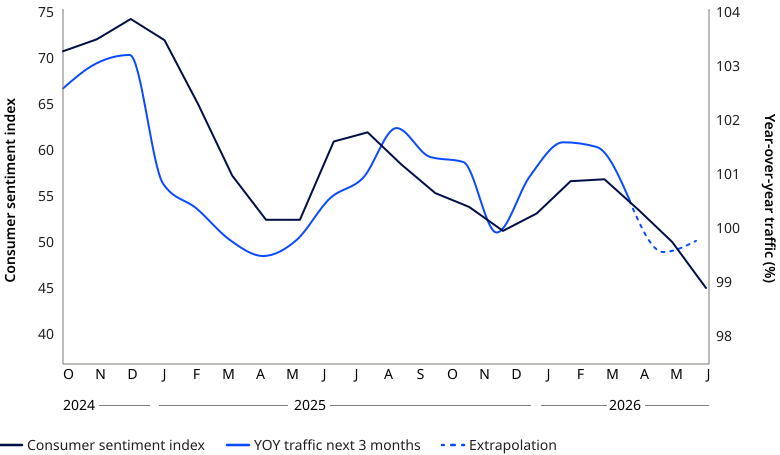
The outlook for the rest of the year is less certain. Higher ticket prices, average fares in the US have increased each month of the conflict, reaching +21% in April, which is likely to lower demand. Flat margins on higher fuel costs are possible for carriers, but softening consumer sentiment indicates downside traffic risk later in 2026.
Global airline market share at risk as Middle East conflict persists
The conflict in the Middle East raises a strategic question that goes beyond managing fuel costs. The global aviation system has increasingly relied on Dubai, Doha, and Abu Dhabi as critical connecting hubs linking Europe, Asia, Africa, and Oceania. If regional instability persists, airlines may face a fundamental shift in passenger behavior.
Corporate travel managers and premium passengers—historically among the most profitable customer segments—may become less willing to route through the region, even if operations remain largely uninterrupted.
The industry's competitive landscape could then change rapidly. European and Asian network carriers may emerge as unexpected beneficiaries, capturing premium traffic flows that have increasingly migrated to Gulf carriers over the past decade.
The current geopolitical crisis could ultimately become a network- and market-share event, challenging one of the most successful airline business models of the modern era.
For carriers, the key question for the rest of 2026 is whether they can adapt to a world in which both the economics of flying and the geography of global connecting traffic are being reshaped.
Sign up for quaterly updates with our Airline Economic Analysis insights.
