


As the six Gulf Cooperation Council (GCC) nations accelerate their governmental adoption of artificial intelligence, their expectation is straightforward: Better technology should help them move faster and make better decisions.
Yet many public institutions face a challenge that technology alone cannot solve. As governments take on more initiatives, coordinate across larger ecosystems, and respond to increasingly sophisticated demands, the pressure on institutional decision-making continues to grow, creating a widening gap between the complexity governments must manage and the capacity available to manage it effectively.
In the GCC, Saudi Vision 2030 tracks more than 1,290 active initiatives, hundreds of performance indicators, and reforms across dozens of government entities.
The UAE faces a similar dynamic. Alongside national transformation programs like the Projects of the 50, the UAE is simultaneously pursuing large-scale AI deployment, digital government integration, service automation, and cross-sector modernization agendas. These include frameworks such as the UAE Digital Government Strategy 2025 and the UAE Strategy for Artificial Intelligence.
Meanwhile, Qatar is experiencing comparable pressures through the interaction between Qatar National Vision 2030 and the country’s Digital Agenda 2030, which seeks to accelerate digital transformation across government entities, service integration, and economic diversification simultaneously.
It’s a challenge that extends outside the region too, with governments in the Organization for Economic Co-operation and Development also facing rising fiscal pressure, expanding service expectations, and growing coordination demands across increasingly interconnected policy agendas.
How AI can increase complexity in government transformation
As governments pursue large-scale transformation programs, they are simultaneously advancing AI adoption, economic diversification, and digital service modernization. Rather than simplifying the government workload or making operations more efficient, these ambitions are increasing the volume of decisions, coordination requirements, and interdependencies that public institutions must manage every day.
As senior leaders spend more time processing information, reviewing reports, coordinating stakeholders, and resolving escalated issues, decision cycles lengthen, and valuable leadership attention is diverted from strategic judgment to operational activity.
This matters because AI tends to amplify existing organizational characteristics of systems to which it is applied. In institutions with clear processes and strong decision-making structures, AI can help simplify processes and strengthen judgment. But in overloaded environments, it can increase the volume of information, accelerate activity, and reinforce existing weaknesses.
Why government AI initiatives can underdeliver
Many governments today are trying to balance two different types of institutional load: intrinsic and extraneous.
Intrinsic load is the unavoidable complexity associated with governing. Challenges such as economic diversification, energy transition, healthcare reform, national security, crisis response, and AI regulation require difficult trade-offs across interconnected systems. As governments become more ambitious and interconnected, this complexity naturally increases.
On the other hand, extraneous load is the complexity that institutions create for themselves. This includes duplicative reporting, fragmented information flows, excessive approvals, unclear decision rights, overlapping governance structures, and repetitive coordination activities. These demands consume time and attention without necessarily producing or improving outcomes.
When unnecessary institutional friction grows, it reduces decision bandwidth — the limited capacity leaders have for prioritization, evaluation, strategic judgment, and trade-off decisions. As this uniquely human capability becomes constrained, institutions can end up spending more effort and time managing activity than addressing the policy challenges that matter most.
The most effective AI deployments are aimed at reducing institutional friction, helping leaders process information more effectively by synthesizing large volumes of material, retrieving institutional knowledge, and reducing administrative burdens. But realizing these benefits depends on the quality of the underlying operating model.
A smarter sequence for government AI transformation
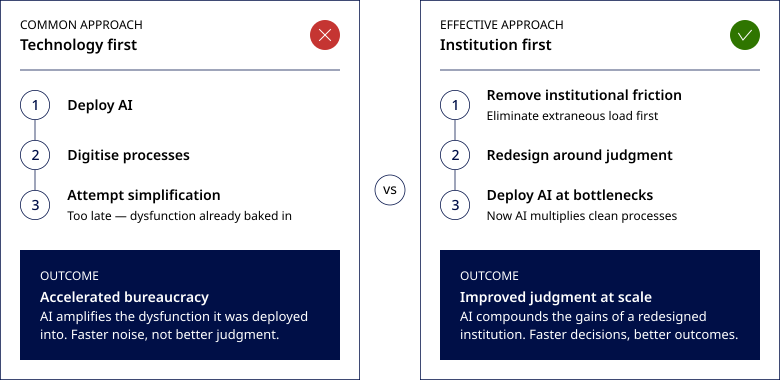
If organizations digitize inefficient processes without redesigning them, AI can exacerbate existing bottlenecks rather than eliminate them. AI transformations struggle most when institutions attempt to automate complexity rather than simplifying it before applying AI.
An alternative sequence for AI deployment can eliminate this risk, with the first step being to reduce unnecessary institutional friction. This involves simplifying governance structures, clarifying decision rights, eliminating duplicative reporting, and streamlining escalation pathways.
The second step is redesigning work around judgment, distinguishing between activities that require human capabilities and those focused more on coordination, retrieval, or administration. This creates opportunities to direct talent and attention toward higher-value decision-making.
Only after these two steps should AI be deployed against the most significant cognitive bottlenecks. In this model, technology ends up supporting cleaner processes and strengthening institutional capacity rather than amplifying existing complexity.
Rethinking the role of AI in government performance
As governments continue to advance ambitious AI agendas, the challenge may be less about the speed of deployment and more about the conditions into which AI is introduced.
Our latest report argues that institutional complexity has become a hidden constraint on government performance. Addressing that constraint requires leaders to look beyond technology adoption alone and focus on how institutions absorb complexity, allocate attention, and preserve decision quality. AI can play an important role in that effort, but only when paired with the organizational redesign needed to ensure its successful deployment.
For public-sector leaders for whom AI adoption now feels inevitable, the central challenge is to ensure that organizations take on the bureaucratic complexity that would otherwise undermine AI implementation.
