


Embedded finance has moved from a niche concept to a growth lever. Non-financial platforms are enhancing their digital experiences by integrating payments, lending, and other banking functions. After gaining traction in consumer markets, embedded finance is gaining momentum in the business-to-business (B2B) space, especially among small and medium-sized enterprises (SME).
Two forces are driving this shift. First, more SMEs are running operations on industry‑specific software, including inventory management, scheduling, procurement, payroll, and invoicing. Second, traditional financial institutions have limited ability to offer flexible, context‑specific services tailored to sectors such as hospitality, professional services, beauty and wellness, healthcare, and construction. Still, adoption is uneven.
SME adoption of embedded finance and the opportunity for ISVs
Roughly 46% of SMEs actively use embedded finance, according to our recent survey of more than 150 companies in France, Germany, and the Netherlands. Even in advanced European markets, embedded finance accounts for only one-third of SME payment volumes, compared to two-thirds in the United States.
Hover over the blue dots to reveal the content
Swipe image to see full content
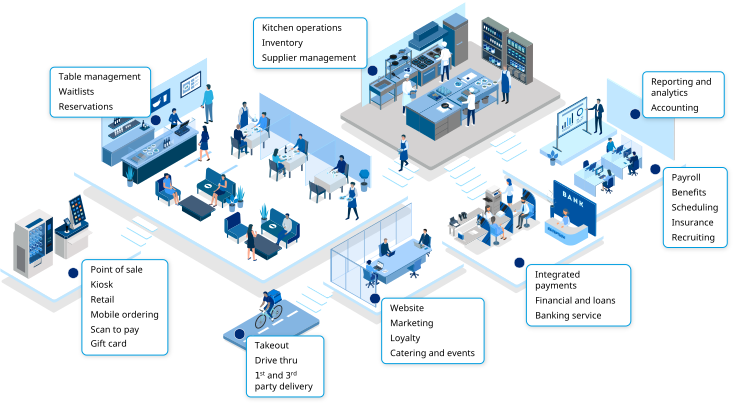
This presents a significant growth opportunity for independent software vendors (ISVs). By embedding payment solutions, working capital products, and other daily banking tools into their platforms, ISVs can deliver quicker access to payments; consolidate the number of providers an SME uses; improve the customer experience; and simplify operations, data management, and reporting. It also adds new revenue streams, bolsters customer retention, and offers significant access to data and insight into the customer base.
Still, significant barriers to adoption exist. Many SMEs see limited incentive to move away from traditional banking relationships, and awareness of embedded finance options remains low.
Providers that succeed will make the value tangible by bundling software and financial services into integrated solutions, offering clearer insights from operational data, and explaining how these tools directly improve cash flow and simplify operations. And our survey, which included SMEs in retail, hospitality, and beauty and wellness, suggests that the growth opportunities are real: 69% of SMEs are interested in using embedded finance products and 64% plan to use new or additional embedded finance products through their software provider in the next 12 months.
Survey shows strong SME demand for embedded finance solutions
More than 44% of SMEs we surveyed already use a form of embedded payment, primarily to accept payments. Lending is emerging as a popular option, with over 40% of SMEs indicating interest in directly accessing lending options through their software platform. This is a key area of innovation.
Instead of relying on a narrow snapshot and fixed repayments, providers can use real‑time operational data to promote pre‑approved offers when they are most relevant and allow repayments that flex with sales. Other products including cards, business accounts, insurance, and investments are early in the adoption curve as demand and interest from SMEs gradually picks up.
While certain vertical-specific ISVs are strongly positioned to lead, SMEs are gravitating toward existing platforms as entry points. More than half (53%) of survey respondents identified accounting and enterprise resource planning software as their preferred platform for accessing embedded finance products. In fact, 79% of SMEs consider embedded finance a key buying criteria for their software solutions.
E‑commerce platforms drew the next‑highest interest, at 45%, underscoring their role as a gateway for embedded finance. As one B2B e‑commerce general manager noted, “We’d like instant loan decisions and lending offered directly through our e‑commerce platform.”
Across survey responses, SME executives emphasized the need for software providers to know their industry. “The provider must have a deep understanding of our company's operations and needs,” wrote one e-commerce head of sales and marketing. This, they said, “will make subsequent collaboration and related services more beneficial.”
They also want tailored recommendations and simpler, more flexible tools that integrate with their financial processes. Without those improvements, SMEs are struggling to find the value proposition to justify switching from traditional financial solutions.
Key strategies for financial institutions and ISVs in Europe
To map out a strategy for Europe, financial institutions and ISVs should start by examining the market and determining which customer segments they want to serve.
A competitive analysis will be required to determine which products already exist in that market. Then, they should assess their strengths, the role they can play in embedded finance, and what success looks like. Financial institutions, for instance, might act as a regulated entity, or they could develop their own software solution, which is far more challenging.
The next step is to identify internal capability gaps. That means figuring out which capabilities to build in-house, when to partner with a vendor, and when to pursue an acquisition. As embedded finance matures over the coming decade, the relationships between software vendors and financial institutions will evolve. We foresee four scenarios:
- Banks attempt to retain payment flows and customer relationships by building or acquiring software solutions. However, acquisitions are expensive, and in‑house development sits outside most banks’ core strengths, making this path relatively unlikely.
- A more plausible outcome is that software platforms broaden their payment capabilities while banks defend customer relationships through differentiated, customer‑centric innovation. By tailoring services to SMEs and making their value more tangible, banks can build defensible service moats.
- The most likely scenario is a split model in which vendors own the front end and banks operate the regulated back end. Software providers lead on user experience, payments, and distribution, while banks supply capital, licenses, and infrastructure through partnerships. Vendors capture much of the commercial value but remain dependent on banks for regulated services.
- A small number of vendors may pursue full banking licenses, but doing so requires deep risk and financial management capabilities and fundamentally alters return profiles, making this an unlikely route for most.
Embracing a strategic approach for financial institutions and ISVs
The key to success will be a strategic — not an opportunistic — approach. This applies to both financial institutions and ISVs. Successful providers will bundle services and create a user experience tailored to key workflows in a targeted industry segment. To achieve this, they should evaluate the competitor and partner landscape. They will also need to assess their own capabilities and ability to stay ahead of the competition, and figure out the most suitable operating model.