

Generative artificial intelligence (AI) and autonomous digital agents have moved from fringe experiments to the very center of the publishing business model. In barely 24 months they have forced many publishers to rethink everything from copyright strategy and newsroom workflows to how they monetize attention. In the same window, Google’s AI-generated “Overviews” have begun siphoning a meaningful share of search-originated traffic, while a flurry of multimillion-dollar data licensing deals has signaled that high-quality journalistic and educational content may finally have pricing power in the AI era.
The result is a strategic knife-edge: Applied wisely, these technologies can cut unit costs by double digits and unlock premium services that publishers once only imagined; mishandled, they threaten to divert 30% or more of audience reach and advertising value to platform-owned “zero-click.”
According to a recent Oliver Wyman survey of 150 industry leaders, AI-driven content creation is anticipated as the single most transformative force shaping the future of the industry over the coming decade. In the near future, AI will streamline editorial workflows, empower the scalable generation of personalized content, and optimize content distribution across diverse platforms and audiences — yielding remarkable gains in both efficiency and audience engagement.
AI’s growing threat to digital publishing
The threat of AI-generated content summaries is more than just a minor inconvenience; it fundamentally undermines the economic foundations of digital publishing, which have long relied on robust, organic traffic to drive advertising revenue and subscription growth.
Publishers can no longer view defensive traffic protection as a peripheral issue. They must recognize it as a strategic imperative to safeguard core audience channels while adapting to AI-driven shifts in content discovery and consumption.
The strategies they adopt must go beyond traditional SEO and content marketing tactics, to include licensing archival content to AI developers as a new revenue source, transforming zero-price scraping into recurring cash flow, and leveraging AI to offer higher-yield ad formats and personalized, AI-curated experiences that reinvigorate direct audience engagement.
Furthermore, embedding AI into product design — such as conversational interfaces and personalized subscription bundles — can help reclaim and stabilize traffic by meeting evolving consumer preferences dynamically. Without decisive action to integrate AI proactively into traffic and monetization strategies, publishers risk losing their economic footing and ceding market control to platform giants that own the AI-powered engagement ecosystems.
Three categories for using AI to change the face of the publishing industry
Boosting revenue with AI licensing and engagement tools
Since mid-2023, publishing has begun shifting data licensing from a defensive approach to a meaningful revenue source. Leading publishers partnering with AI innovators like OpenAI are realizing significant new income streams — potentially hundreds of millions of dollars — that can support ongoing innovation and growth.
AI is increasingly driving deeper audience engagement and improved monetization across sectors. For instance, AI-powered audio features have shown the potential to increase user engagement by double digits and reduce churn. Education publishers report that AI-enabled study tools boost student focus and raise digital upsell rates. News organizations deploying AI-generated explainers are achieving substantially higher ad rates, while professional information providers attribute notable profit gains to AI-enhanced analytics subscriptions.
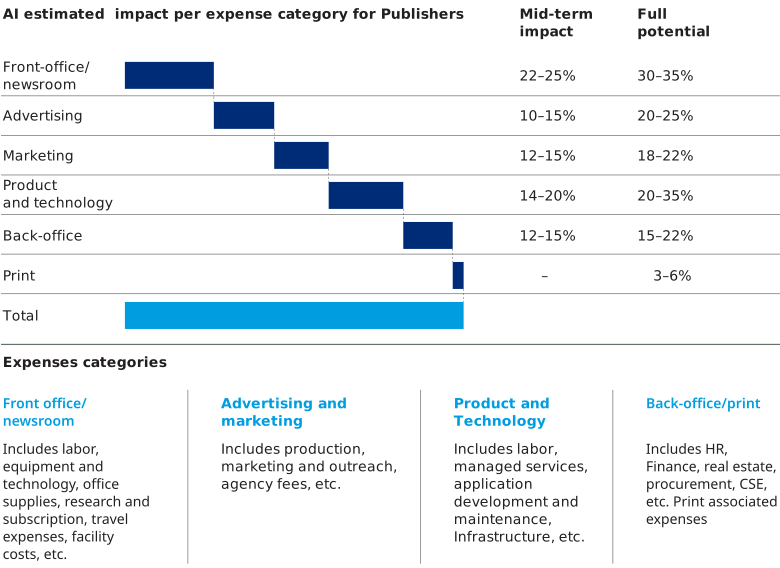
Optimizing efficiency and costs with AI
For publishers facing margin pressures, AI offers the fastest path to sustainable cost reduction and accelerated cycle times across the entire value chain. Early adopters who industrialize AI capabilities will secure durable competitive advantages, unlocking both efficiency gains and new growth opportunities.
Overall, these operational advances will enable publishers to reduce production costs by approximately 20-30%, accelerate content delivery, and lower labor costs by up to 40%. Importantly, such gains will be achieved without compromising — and often will improve — content quality and audience engagement. This strategic alignment positions publishers for long-term sustainable profitability and competitive advantage in the fast-evolving AI-powered media environment.
Innovating and evolving publishing using AI
AI is reshaping content consumption into an active, exploratory journey. Looking ahead, the publishing landscape will be defined less by page views and more by AI-enabled services that become indispensable to readers and enterprises alike. Those who build dedicated AI capabilities, design conversational and agent-driven products, and adopt agile pricing strategies will lead the industry’s next decade of growth and margin expansion. Publishers who hesitate risk ceding ground to more innovative, AI-native competitors — losing both audience loyalty and financial strength.
How publishers can capture the AI opportunity
Unlocking the true value of AI-enabled transformation is fundamentally about enhancing business outcomes. For publishers, this means reimagining business processes and operating models from end to end. Publishers can use the following checklist to ensure they are leveraging the full potential of AI and agentic ecosystems:
- Develop a holistic vision for AI within the organization and assess the return on investment of AI and digital agent initiatives, rather than engaging in isolated AI projects
- Focus on optimizing entire business areas, including internal processes and operations, rather than implementing narrow use cases in isolation
- Integrate AI, generative AI, and agentic systems to create a cohesive strategy, instead of relying solely on AI for transformation
- Utilize multiagent systems to automate complex workflows, rather than depending on a single model to handle diverse tasks
- Prioritize the reusability of AI components to avoid starting each project from scratch and to enhance coordination across initiatives
- Make people responsible for value capture, either by creating a value capture office with a lean team or an agile pod allocating responsibilities across functions
- Anticipate changes in the industry and invest in reskilling employees to support transformation efforts throughout the organization
Ultimately, success depends on integrating these imperatives into a coherent transformation agenda — where defending audience reach, operationalizing AI efficiency, and pioneering new monetization paths converge. Publishers who embrace rapid experimentation and continuous iteration, while building sustainable AI capabilities and data assets, will shape the industry's economic future.